

Bloomberg New Economy Climate Technology Coalition Makes First Statement on Decarbonizing Ammonia Production Using Clean Hydrogen
Bloomberg New Economy Climate Technology Coalition Identifies Potential to Decarbonize Ammonia Production Using Clean Hydrogen
The first in a series of sectoral reports explores the global direction of low-carbon ammonia production; commissioned report from BNEF sets out commercial and policy considerations for unlocking industrial-scale supply and demand for clean hydrogen
New York, November 28, 2023 – Today, Bloomberg’s New Economy Climate Technology Coalition (“the Coalition”) released its report on decarbonizing ammonia production using clean hydrogen. Research prepared by BloombergNEF (BNEF) incorporating insights and approaches from members of the Coalition identifies ways to accelerate industrial demand for low-carbon ammonia, where large-scale decarbonization of its production chain will lead to significant greenhouse gas emissions cuts in agriculture, shipping and chemicals.
With its mission to rapidly scale the next generation of climate-critical green technologies to accelerate the transition to the low-carbon economy, members of the Coalition alongside BNEF research analysts have put forth a set of potential commercial actions and policy considerations that could set the industry on a faster path to decarbonization. Ongoing clean ammonia projects of the certain members further reinforce the opportunities highlighted in the report.
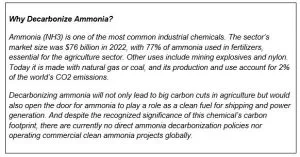
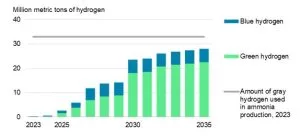
The analysis shows potential for decreasing green hydrogen costs, identifying pockets of demand, and increasing clean hydrogen and ammonia production capacity. BNEF data also reveals the current pipeline of low-carbon ammonia projects waiting to be built by 2035 is large enough to decarbonize most of today’s ammonia sector (approximately 187m tons annually).
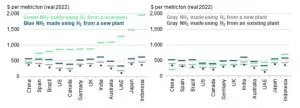
Cost of ammonia production in 2023 (left), 2030 (right)
Source: BloombergNEF
BNEF projects green ammonia costs to reach parity with gray in some markets from 2024-2025 and become cheaper than gray in more than half of 29 markets modeled by BNEF from 2034.
Announced low-carbon H2 production destined for ammonia production
Source: BloombergNEF
The pipeline of low-carbon ammonia projects waiting to be built by 2035 is large enough to decarbonize most of today’s ammonia sector
The commissioned report analyzes the current challenges to decarbonizing the sector and how companies and governments are beginning to overcome them. While there is market demand driving low-carbon ammonia pilot projects, the high cost of making it, together with its long, fragmented supply chain are impediments to wider adoption. BNEF analysts state a number of commercial actions and targeted intervention from supportive governments would be needed to decarbonize ammonia over the next ten years.
“This report helps to shine a light on the potential for clean hydrogen to rapidly decarbonize our agriculture, shipping and chemical industries. Price reduction through medium and long-term offtake agreements will be critical for the ammonia industry to bind to clean hydrogen, and the Coalition Steering Committee will take on board the findings in this report to further accelerate this process,” said Neil Shen, Founding and Managing Partner of HongShan (Sequoia China).
Potential commercial and policy actions:
Commercial actions
- Signaling investment appetite through ‘Clean Ammonia 100’: A ‘Clean Ammonia 100’ coalition, acting in accordance with antitrust laws, could bring together the brands whose emissions (be it Scope 1, 2 or 3) are most impacted by ammonia. Precedents include the Climate Group’s EV100 and RE100. By communicating a keen interest in and support for low-carbon ammonia, this group could provide a positive signal to investors and financiers of production. Members could be large food and beverage brands whose Scope 3 emissions are impacted by gray fertilizer as well as companies that are new to the ammonia sector such as shipping firms.
- Adoption of a ‘ladder’ approach: In order to scale demand as quickly as possible, low-carbon ammonia project developers could employ a ‘ladder’ approach. Rather than a full-scale transformation of the entire ammonia supply chain, producers can instead identify near-term pockets of low-carbon ammonia demand to sell into and get early production up and running or retrofitting retired gray ammonia facilities, which can be done faster than building on new sites.
Policy actions
- Reduce agricultural sector exposure to international natural gas price volatility: Regions with abundant renewable resources but limited natural gas could focus on the production of domestic green fertilizer as a way of reducing the exposure of their agricultural sectors to international natural gas supplies. This could increase economic security and be cheaper than importing gray ammonia or fertilizer.
- Shift agricultural subsidies to low-carbon fertilizer: Where governments already subsidize the purchasing of gray fertilizer for farmers, these subsidies could explore directing that funding to the purchase of low-carbon fertilizer.
- Establish complimentary supply and demand subsidies and mandates: Government support for new technologies works best when there is a mandate to make, or buy, that new product, paired with a subsidy for production. Policy makers could establish mandates to replace gray ammonia with low-carbon ammonia, paired and calibrated with financial support for ammonia producers or users to improve economics.
“There are currently no policies directly targeting the decarbonization of the ammonia-based fertilizer industry. However, we are beginning to see the emergence of broader chemical and agricultural decarbonization policies in markets such as Europe, making the publication of this report very timely. BNEF and the CTC hope that these findings will be useful building blocks for the policy discussions being held at COP28,” said Claire Curry, head of Technology, Industry & Innovation research at BloombergNEF.
“Green hydrogen will be an integral part of the new renewable energy system, accelerating affordable and clean energy to many key industries including agriculture. While private enterprises take on the risk of investing in innovation, we need to continue a healthy dialogue with policy makers to accelerate the global shift to a greener economy,” said Lei Zhang, Founder and CEO, Envision.
“Scaling up the production and adoption of green hydrogen and green ammonia is critical to decarbonizing heavy emitting sectors,” added Mark Carney, UN Special Envoy for Climate Action and Finance and Chair of Brookfield Asset Management; Head of Transition Investing; Chairman of the Board, Bloomberg. “Pioneering investors and companies are leading the way in this energy transition, but we now require large-scale collaboration between industry, finance and policy to rapidly scale projects on the ground and accelerate the growth of this critical new technology.”
Launched at the 2022 Bloomberg New Economy Forum, the Bloomberg New Economy Climate Technology Coalition was formed with the aim of identifying and rapidly scaling the next generation of climate-critical green technologies that will be instrumental in achieving the world’s climate goals. Led by a global Steering Committee of established leaders from across sectors and industries, this Coalition has set an ambitious agenda to unlock pathways to accelerate this timeframe to within a decade.
The Coalition Steering Committee possesses a global breadth and depth of expertise, bringing together leaders from India, China, North America, Africa, Europe, Australia, and the Middle East including: Michael R. Bloomberg, 108th mayor of New York City and founder of Bloomberg Philanthropies, Mark Carney, UN Special Envoy for Climate Action and Finance and Chair of Brookfield Asset Management; Head of Transition Investing; Chairman of the Board, Bloomberg, Natarajan Chandrasekaran, Chairman, Tata Sons, Bruce Flatt, CEO, Brookfield Asset Management, Andrew Forrest, Chairman and Founder of Fortescue, Sara Menker, Founder and Chief Executive Officer, Gro Intelligence, H.E. Khaldoon Khalifa Al Mubarak, Managing Director and Group CEO, Mubadala Investment Company, Neil Shen, Founding & Managing Partner of HongShan (Sequoia China), Lord Adair Turner, Chairman, Energy Transitions Commission, and Lei Zhang, Founder and CEO, Envision.
Over the next two years, the Coalition will work to assess two other low-carbon hydrogen related technologies, including the production of steel and methanol, that over the next decade will need to overcome production hurdles to scale in order to accelerate the low-carbon transition.
ENDS
About the Bloomberg New Economy Climate Technology Coalition
The Bloomberg New Economy Climate Technology Coalition aims to identify and rapidly scale the next generation of climate-critical green technologies that will be instrumental in achieving the world’s climate goals. It took several decades for renewables to reach today’s scale. The Coalition has set an ambitious goal to accelerate this timeframe to within a decade. It is led by a global steering committee of established leaders from across sectors and industries.
About BloombergNEF
BloombergNEF (BNEF) is a strategic research provider covering global commodity markets and the disruptive technologies driving the transition to a low-carbon economy. Our expert coverage assesses pathways for the power, transport, industry, buildings and agriculture sectors to adapt to the energy transition. We help commodity trading, corporate strategy, finance and policy professionals navigate change and generate opportunities.
ADDENDUM
Bloomberg New Economy Climate Technology Coalition Member Spotlights
Brookfield
Brookfield, through its portfolio company, Avaada Group, is helping advance the development of green hydrogen projects in India.
The company’s foray into green hydrogen and its derivatives is part of the global energy transition theme and Government of India’s target to produce 5 million metric tons of green hydrogen by 2030 and the related development of renewable energy capacity under the National Hydrogen Mission.
Avaada Group’s first green hydrogen and freen ammonia project is being developed on India’s eastern coastal state of Odisha. For the project, Avaada has partnered with another Coalition member, TATA Group, through their Tata Steel Special Economic Zone (TSSEZL) located near Gopalpur Port. Avaada signed a memorandum of understanding (MoU) with Gopalpur Port Limited to set up infrastructure facilities to support the development of the project including storage tanks and pipelines. While the company is in the process of securing the L-EPC contracts for the project, the renewable energy project dedicated for the green hydrogen and ammonia project – a key component of the project economics – will be developed in-house by Avaada, leveraging the company’s long-standing expertise and experience in clean energy. Alongside the ongoing infrastructure development, Avaada is actively pursuing long-term offtake arrangements with corporates across markets in Asia and Europe for the delivery of Green Ammonia from the project.
Avaada Group is an integrated energy platform in India with multifaceted interests spanning the manufacturing of solar PV modules, renewable power generation, green hydrogen and its derivatives like green methanol, green ammonia and sustainable aviation fuel. Avaada Energy, flagship arm of the group and responsible for renewable power generation business, is targeting 11 gigawatt (GW) installed capacity by 2026.
For more information, visit https://www.brookfield.com/.
Envision
In response to the critical need for sustainable industrial practices, Envision Energy’s green hydrogen project emerges as a key innovator in the field. Located in the eastern part of Inner Mongolia, Envision Energy’s green hydrogen project marks the world’s first commercial green hydrogen project. The project progresses through various phases, each marked by increased capacity and varied product offerings. In the initial phase (P0), it will start with 20,000 tons per year of green ammonia production. The following phase (P1) scales up to a production of 300,000 tons of green ammonia per year. The project has been strategically selected to leverage one of the world’s best wind and solar resources with an average wind speed exceeding 8 meters per second and a loading factor of over 3,500 hours per year, and the proximity to Bohai Bay further bolsters the project’s strategic advantage.
Envision Energy is revolutionizing the green hydrogen industry by optimizing cost and promoting environmental sustainability. At the core of Envision’s project are state-of-the-art technologies that address key challenges in the green hydrogen arena, particularly those related to efficiency and the intermittency of renewable energy sources. Pioneering its own alkaline and PEM electrolysis technologies, green hydrogen / ammonia solution, engineering competences and system integration capabilities, Envision has been able to facilitate the green hydrogen industry moving at commercial scale.
The green hydrogen project by Envision Energy stands as more than just a technological venture; it is a strategic initiative addressing the increasing demands for sustainable solutions in the industrial sector. The project is set to have a profound industry impact, bringing pivotal advancements to the green hydrogen value chain, and establishing itself as a technology leader. It will also significantly impact clients/customers by demonstrating the real-world viability of green hydrogen business without government subsidies, thus settling debates about its feasibility and potential profitability. Poised to be a frontrunner in the green hydrogen movement, the project marks a critical step in the journey towards transforming hydrogen and derivatives production and championing a low-carbon future.
For more information, visit https://www.envision-group.com/.
Fortescue
Fortescue is focused on becoming the No. 1 integrated green energy, metals and technology company, recognized for its culture, innovation and industry-leading development of infrastructure, mining assets and green energy initiatives.
It operates with two divisions – Metals and Energy.
Fortescue is committed to producing green hydrogen, containing zero carbon, from renewable electricity.
Green hydrogen is a zero-carbon fuel that, when used, produces primarily water. It is a practical and implementable solution that can help revolutionize the way we power our planet: helping to decarbonize heavy industry and create jobs globally.
Fortescue is leading the green industrial revolution, building a global portfolio of renewable green hydrogen and green ammonia projects. These include a joint venture with Incitec Pivot Limited (IPL) for the conversion of IPL’s existing Gibson Island ammonia facility to run on green hydrogen. The proposed project could see the construction of a new 550 megawatt (MW) hydrogen electrolysis facility at the site to produce green hydrogen as well as the retrofitting of IPL’s existing ammonia manufacturing facility to run on the green hydrogen produced onsite.
The Fortescue Green Pioneer is a symbol to the world of the technology solutions needed to decarbonize shipping. Fortescue successfully converted a four-stroke engine to run on ammonia at its Perth testing facility earlier this year, marking a major milestone in its pursuit of a global shipping industry no longer reliant on fuel oil.
The Company has since converted its proof-of-concept Green Pioneer to run on ammonia at the marine vessel’s home port of Singapore, as Fortescue pursues its broader plan for a world-first marine vessel with approval to use ammonia as a fuel.
The technology being developed is expected to enable the Green Pioneer to run on ammonia, which does not contain carbon and can be produced using renewable energy, and other fuels made using renewable energy.
Fortescue is also leading the global effort to help decarbonize hard-to-abate sectors. This includes developing and acquiring the technology and energy supply to help decarbonize the Australian iron ore operations of one of the world’s largest producers of iron ore, Fortescue Metals, by 2030 (Scope 1 and 2 terrestrial emissions).
For more information, visit https://fortescue.com/.