

Bloomberg New Economy Climate Technology Coalition Identifies Pathway for Clean Hydrogen Adoption to Decarbonize Methanol Production
Methanol is currently produced using fossil fuels and contributes to 0.7% of global CO2 emissions. The report prepared by BloombergNEF suggests that low-carbon methanol may become the most important driver of clean hydrogen demand in the near term, consuming more than 1.65 million tons annually by 2028.
New York, May 30, 2024 – Today, Bloomberg’s New Economy Climate Technology Coalition (“the Coalition”) released its latest report on decarbonizing methanol production using clean hydrogen. Research prepared by BloombergNEF (BNEF) incorporates insights and approaches from Coalition members and outlines commercial and policy considerations to accelerate the transition to low-carbon methanol, which will play a crucial role in reducing greenhouse gas emissions.
The analysis [insert link] details how decarbonizing methanol will help reduce emissions in the chemicals and materials sector, as well as the shipping industry. While there is less demand for replacing gray methanol with green methanol in the chemicals industry, the report shows the shipping industry has been moving faster – regulations in the EU and a new net-zero goal by the International Maritime Organization have been key drivers in pushing container shipping to procure clean fuels. BNEF estimates that the planned capacity of low-carbon methanol projects globally could consume more than 1.65 million tons of clean hydrogen annually.
Planned supply of low-carbon methanol based on project pipeline, and projected demand from the shipping sector based on ship orders
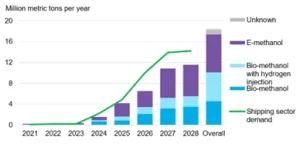
Source: BloombergNEF. Project pipeline is as of January 5, 2024.
The report reveals conventional methanol production is currently heavily reliant on fossil fuels, contributing 261 million tons of CO2 in 2022, or about 28% of primary chemical production emissions. Bio-methanol and e-methanol can significantly reduce or even eliminate the carbon emissions associated with methanol production. A key challenge to scaling clean hydrogen adoption is the lack of international consensus on what constitutes low-carbon methanol, though the report details some national and corporate-led standards are emerging.
“Accelerating the adoption of low-carbon methanol involves identifying early-stage offtakers in the chemicals and shipping sectors. This report pinpoints these potential adopters through case studies and original analysis. For instance, medical companies, furniture product producers and renewable equipment manufacturers should have a strong interest in low-carbon methanol-based materials. The uptake of commercial and policy actions are outlined in this report and help support low-carbon methanol as an attractive option for fuel decarbonization in the European container shipping sector.” Claire Curry, Head of Technology, Industry & Innovation research at BloombergNEF.
Potential Commercial and Policy Actions:
Commercial actions
- Container shipping companies could engage with fuel suppliers upstream and cargo owners downstream to work out potential viable economics for decarbonization.
Low-carbon methanol producers could identify early offtakers in the downstream chemical sectors. Commercial customers in the chemical sector most likely to adopt low-carbon methanol will have a Scope 3 emission target, control or strong influence over their supply chain, and most importantly consider methanol a significant part of the product carbon footprint. - Keep carbon feedstock sources flexible to optimize for local supply chains and costs, while keeping an eye on the carbon footprint. Chinese projects often opt for agricultural waste, while projects in the Nordics have used biogenic CO2 captured from biomass power plants. Low-carbon methanol producers could also keep their output flexible, perhaps choosing to convert methanol to other derivatives such as jet fuel, where demand dictates.
Policy actions
- Customize demand-side regulations by sector. Demand-side regulations would help to scale low-carbon methanol demand, and could take various forms for different sectors. Consumption mandates are the most effective option for the chemical sector, while fuel carbon intensity regulation is more appropriate for shipping.
- Ramp-up incentives and support for producers. Demand-side regulations could be coupled with corresponding supply-side incentives, otherwise companies might decide to pay the penalty rather than switch to clean fuels. Supply-side incentives should focus on the hydrogen feedstock, which is one of the biggest cost drivers for e-methanol today. Policy makers could consider a combination of supply-side incentives, including not only direct subsidies for feedstocks but also loan guarantees and infrastructure grants.
- Establish a clear standard for carbon utilization in green molecules. Policy makers should develop a comprehensive carbon management strategy, as well as address the type of carbon sources that qualify as ‘green’ and the surrounding carbon accounting rules. This would give both methanol producers and buyers more clarity so that they can start locking in long-term supply today. The EU has proposed its first ever industrial carbon management strategy, but there is still some regulatory ambiguity and uncertainty left to be addressed.
You can read the full report here.
Launched at the 2022 Bloomberg New Economy Forum, the Bloomberg New Economy Climate Technology Coalition was formed to help identify and rapidly scale the next generation of climate-critical green technologies that will be instrumental in achieving the world’s climate goals. Led by a global Steering Committee of established leaders from across sectors and industries, this Coalition has set an ambitious agenda to unlock pathways to accelerate this timeframe to within a decade.
The Coalition Steering Committee possesses a global breadth and depth of expertise, bringing together leaders from India, China, North America, Africa, Europe, Australia, and the Middle East including: Michael R. Bloomberg, 108th mayor of New York City and founder of Bloomberg Philanthropies; Mark Carney, UN Special Envoy for Climate Action and Finance and Chair of Brookfield Asset Management, Head of Transition Investing, Chairman of the Board, Bloomberg; Natarajan Chandrasekaran, Chairman, Tata Sons; Bruce Flatt, CEO, Brookfield Asset Management; Andrew Forrest, Chairman and Founder of Fortescue; Neil Shen, Founding & Managing Partner of HongShan (Sequoia China); Lord Adair Turner, Chairman, Energy Transitions Commission; and Lei Zhang, Founder and CEO, Envision.
ENDS
About the Bloomberg New Economy Climate Technology Coalition
The Bloomberg New Economy Climate Technology Coalition aims to identify and rapidly scale the next generation of climate-critical green technologies that will be instrumental in achieving the world’s climate goals. It took several decades for renewables to reach today’s scale. The Coalition has set an ambitious goal to accelerate this timeframe to within a decade. It is led by a global steering committee of established leaders from across sectors and industries.
About BloombergNEF
BloombergNEF (BNEF) is a strategic research provider covering global commodity markets and the disruptive technologies driving the transition to a low-carbon economy. Our expert coverage assesses pathways for the power, transport, industry, buildings and agriculture sectors to adapt to the energy transition. We help commodity trading, corporate strategy, finance and policy professionals navigate change and generate opportunities.