

Overcoming Barriers: Adopting Demand-Side Technologies At Scale
At a glance
- An “electrification hypercycle” is arriving faster than energy supply can keep up, making demand-side flexibility a prerequisite for reliability, affordability, and sustainability.
- The biggest barriers are not technical: fragmented decision-making, misaligned incentives, outdated regulatory compacts, and low trust/low transparency across stakeholders were the barriers most emphasized during the discussion.
- Scaling solutions will require shared standards, interoperable data, and clearer market/regulatory signals, plus “proof points” that show what good looks like to de-risk adoption for operators and leaders. Flexibility is also key to scale across systems, sectors and regions.
At a private roundtable at Bloomberg House Davos 2026, the Bloomberg New Economy’s Energy Technology Coalition, co-chaired with Schneider Electric, convened global leaders to discuss how to overcome barriers to scale demand-side energy technologies. The US and Europe-based participants came from myriad backgrounds including government, utilities/transmission system operators, industrials, built-environment leaders, AI/data center operators, and technology providers.
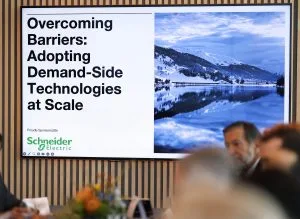
The electrification hypercycle has created an essential need for demand-side solutions
Opening reflections framed the moment as a rapid electrification surge (described as a hypercycle), with demand-side solutions increasingly central to system stability and resilience, affordability, and sustainability. Participants noted that progress in developing demand-side solutions has accelerated in recent years, and many of these technologies already exist. However, adoption is lagging because institutions, markets, and operating models have not caught up.
Coordination, incentives, and trust hinder scaled adoption
Participants agreed the largest barrier to adoption converged around coordination problems: multiple actors (generators, grid operators, regulators, customers, intermediaries) making decisions with different incentives and limited real-time alignment. Several participants argued that flexibility is fundamentally a social innovation challenge—hinging on trust, transparency, fairness, and clear accountability—before it is a technology problem.
“The future of energy is very much about unlocking silos and transversal cooperation across sectors,” noted Frédéric Godemel, Executive Vice President of Energy Management at Schneider Electric and Co-Chair of the Coalition. “Otherwise we risk undoing the progress we’ve made in creating a cleaner, more digitalized energy system.”
A public-sector perspective underscored the complexity of managing a three-way objective set – affordability, energy security and reliability, and sustainability – while slow moving regulations struggle to keep pace with technology and market conditions. Participants emphasized that this complexity makes stable, investable frameworks hard to maintain, yet stability is exactly what market actors need to plan and invest.

Coalition co-chair Frédéric Godemel, EVP of Energy Management, Schneider Electric.
Financial incentives are often “stranded” by structure
Participants repeatedly reinforced that ROI exists for many demand-side technologies, but value capture is inconsistent. In industrial settings, operators pointed to organizational risk aversion and the “who gets rewarded vs. who gets blamed” dynamic (operations versus finance) as a major brake on flexibility, even when capabilities exist.
In the built environment, speakers highlighted a distinct structural barrier: real estate economics and regulation frequently treat energy-related revenue as non-core or even disallowed, turning what could be meaningful incremental value (e.g., from storage, on-site generation, grid services) into a high-friction administrative burden. This reinforces a perception among asset managers that participation is “too difficult,” despite favorable fundamentals.
Market design and regulation are an outdated compact
A sharper thread emerged on regulation: participants argued that many electricity regulatory constructs were designed for a different era of centralized generation, limited visibility, and monopoly control and are now colliding with a world where data, controls, distributed resources, and large flexible loads (including data centers) change what’s possible. Several stressed that utilities often lack incentives to enable third-party flexibility at speed. Others noted that improved market mechanisms and clearer price signals could unlock latent capacity and reduce the need for slower infrastructure expansion.
Solving the AI quagmire
Data center leaders described a practical reality: there can be significant “latent capacity” on grids for much of the year, constrained by relatively few peak hours—suggesting that flexibility mechanisms could unlock capacity quickly if markets, coordination, and data exchange improve. Participants also observed that data center infrastructure could become a platform for demand response “layered” on older grids, if interoperability and operational alignment are solved. But even as AI provides efficiency gains, the exponential growth in data center construction and use is feared to end up leading to the “rebound effect” in which any efficiency gains are eliminated.

Coalition co-chair Frédéric Godemel, and members, Manon Van Beek, CEO of TenneT, and Arch Rao, Founder & CEO, SPAN.
The role of the Coalition: “what good looks like”
When discussing solutions, participants consistently returned to the value of tangible outputs to reduce friction and de-risk adoption of energy technology:
- Proof points and replicable business cases that demonstrate real returns and operational pathways (not just theory).
- Recommendations for regulation and market design, to help stakeholders move from one-off negotiations toward scalable models.
- Establish shared standards, interoperable data, and predictable returns, enabling faster coordination across countries and sectors.
- Identify mental barriers inside organizations (e.g. why proven-ROI solutions still stall) and what changes decision-making behavior at scale.
Over the coming year, the Coalition will work to elevate the following message: technology is progressing, but scaling demand-side solutions will depend on with coordination, action, endorsed standards, and better-aligned incentives that enable practical deployment.
Schneider Electric, who was a sponsor of Bloomberg House Davos, is the founding Co-Chair of the Bloomberg New Economy Energy Technology Coalition, a private sector-driven initiative helmed by a collective of forward-thinking global leaders across industry and infrastructure accelerating the deployment of demand-side technologies. Learn more at bloombergneweconomy.com/EnTech