

A Blueprint for Energy-Efficient Buildings: Breaking Through Financial, Technical, and Mental Blocks
This case study of the Energy Technology Coalition centers around how financial, mental, and technical expertise barriers to adoption of demand-side energy technology were overcome by a Texas-based credit union, Credit Human, as it built its new headquarters. The story exemplifies the Coalition’s mission by showing how the biggest barriers were not unproven technologies, but conventional mental models, flawed financial assumptions, contractor execution, and short-term decision-making, offering a practical roadmap for other organizations to use proven efficiency technologies and model long-term value correctly.
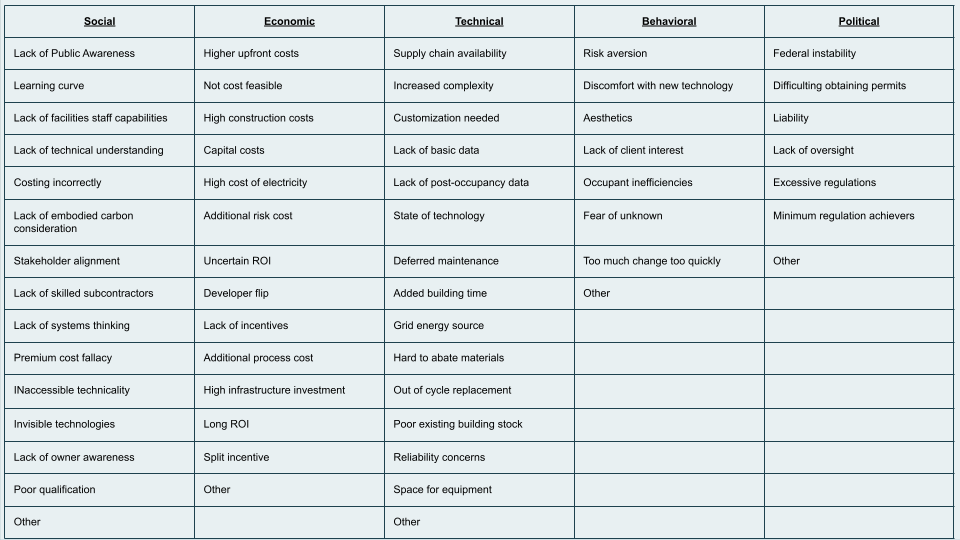
Technology is not the problem. Rather, there are other barriers to the adoption of energy efficiency solutions that are more prevalent and persistent across industries. These include financial, mental, and technical barriers, among others (see table 5). In this case study from the built environment, we examine the barriers a Texas-based credit union faced while trying to build their new headquarters with energy reduction as a core design principle.
One of the first credit unions in San Antonio, Credit Human was founded in 1935 during the Great Depression by 12 federal government workers who pooled together $60 to form the National Federation of Federal Employees Local No. 28. While most credit unions struggled during the second world war, Local No. 28 was an exception and by 1974 passed the $100 million milestone.
Credit Human had been in the same building since 1976, and over a 43-year period, it became clear that it was spending more than 10% of the building’s capital costs on maintenance every year. This begged the question for leadership: If Credit Human was to build a new headquarters, what could they do that’s different—even if constrained by the dynamics of decay and entropy? The team prioritized demand-side energy measures, like a building envelope with solar glazing, water cooled VRF (advanced HVAC), LED lighting, cooling towers, fans and pumps and advanced plug load controls.

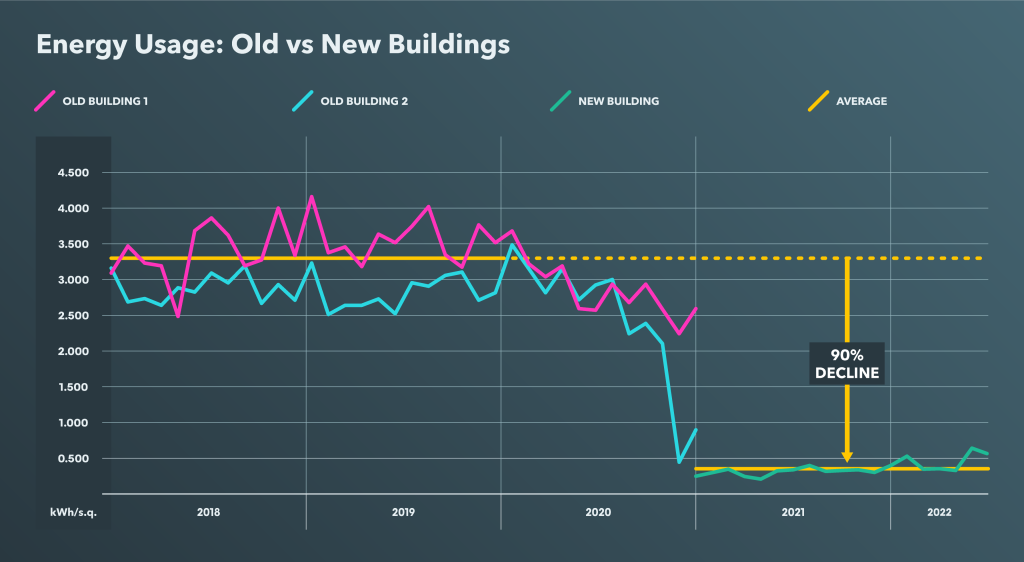
As the new building was designed, pitched, and subsequently built, all stakeholders involved with the project—from Credit Human leadership, the general contractors, to the builders themselves—overcame deep-seated constraints. The result: energy costs that were 5 times lower than a comparable building in San Antonio “built to code.” These significant savings deliver value to Credit Human’s shareholders and have also inspired their sustainable home lending program, which has helped 32,000 families save more than $110 million in energy costs.
False financials
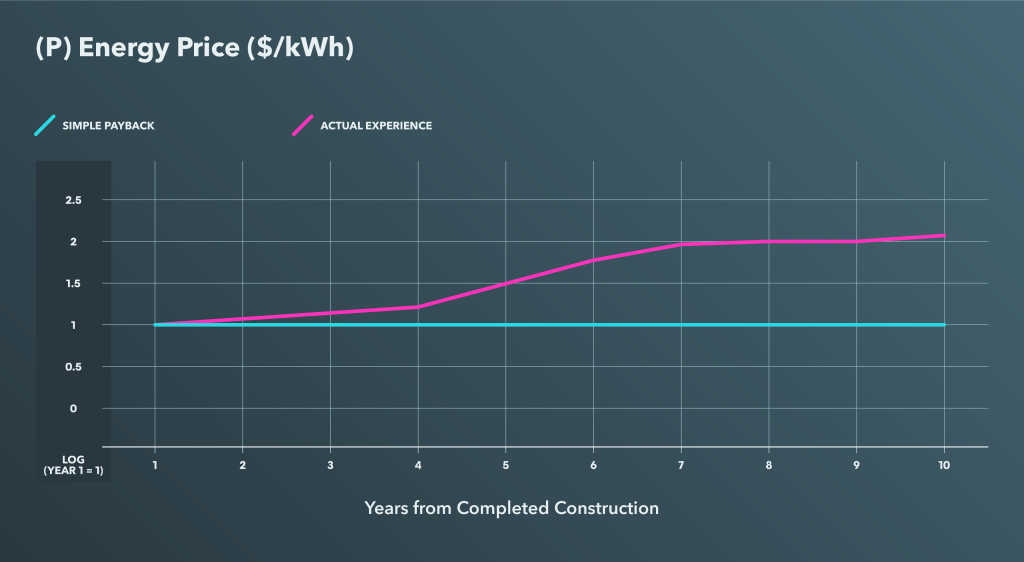
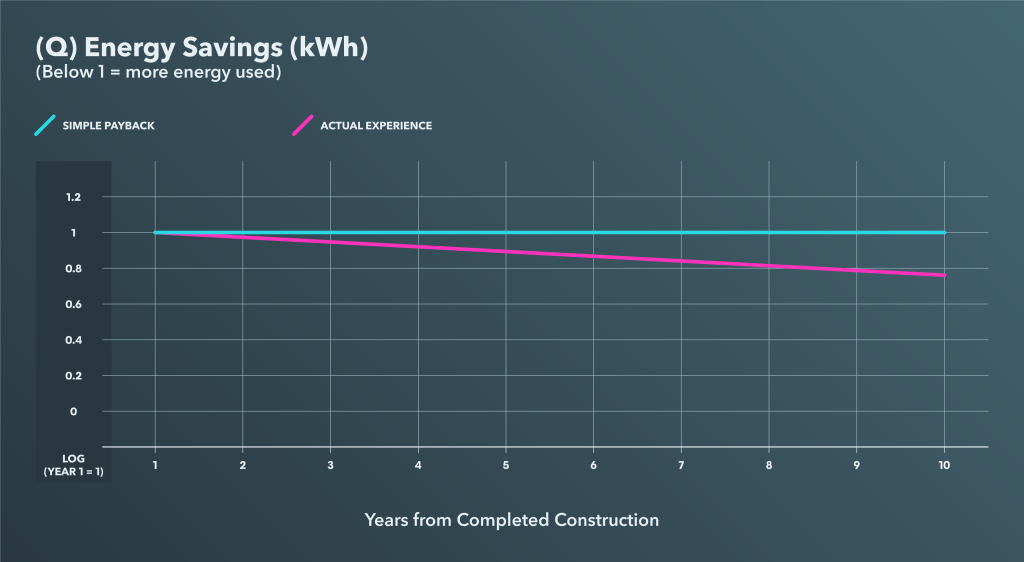
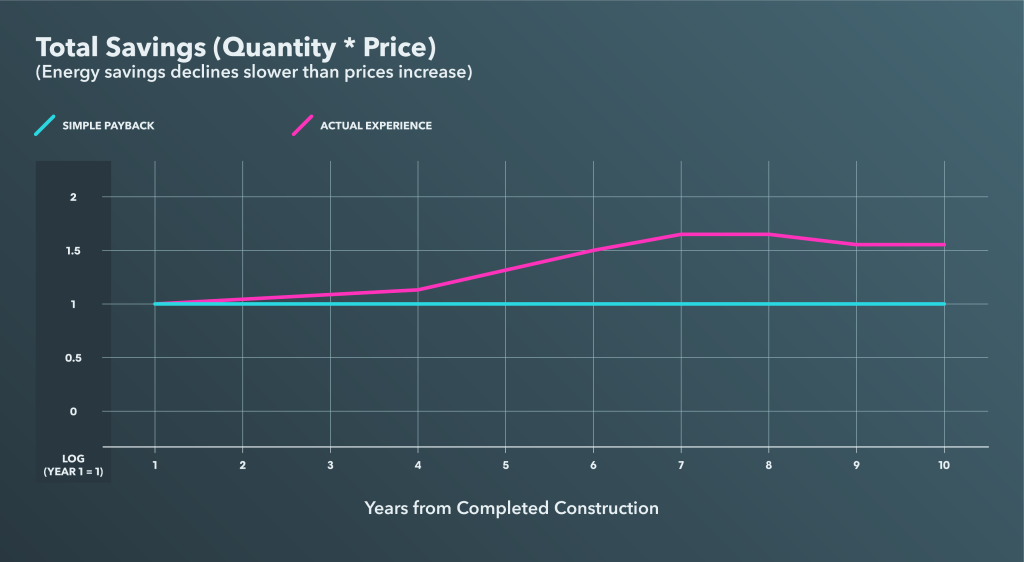
Current cost models and bid practices are built on antiquated assumptions that hinder widespread adoption of low-carbon technologies. For one, most financial modeling relies on simple payback, a calculation of the amount of time required to recover the initial cost of an investment through the cash flows or savings it generates. Simple payback, however, assumes linearity and relies on static assumptions about the price of energy and a building’s decay (e.g., use of energy).
As Credit Human’s CEO Steve Hennigan puts it, “Forty-three years ‘in the building’ and there was nothing linear about the quantity [of energy used] and the price.” While the water and electric bill for that first year of operation in 1976 was around $28,000 for their 110,000 square foot building, by 2020 that bill had ballooned to close to $500,000. This was the effect of compounding increases in utility rates alongside energy use, which rises due to regular wear and tear of the building and machinery, not to mention changing climate patterns—factors which are wholly absent from simple payback models.
Source: Credit Human
Source: Credit Human
Source: Credit Human
“Every time the utility raises its prices, the payback comes even faster,” notes Hennigan. With energy markets witnessing volatility worldwide, it’s this finance lesson that may be the most transferable for decision makers across sectors and geographies. For the new Credit Human building, environmental investments amounted to 4.6% of the project total, with an internal rate of return of 11.45%.
Nevertheless, price signals and high upfront costs—real or imagined—remain one of the principal barriers to decarbonizing buildings, as shown in a recent study The barriers and drivers to decarbonization of the building sector in the United States: Qualitative insights from Boston and Phoenix, co-authored by Boston University Institute of Global Sustainability and Schneider Electric’s Research Institute. Add to that a labor premium due to inexperience using demand-side technologies and investors run into more technical and mental barriers.
Technical training
Among the top barriers to decarbonizing buildings, interviews conducted for the study consistently cited lack of technical understanding, and lack of skilled subcontractors. In order to maintain multiple building systems, the study found, “intensive workforce development” and “investments to bridge learning gaps and new systems of design, procurement, construction, oversight and decommissioning” are required.
Vincent Petit, who leads the Schneider Electric Research Institute, lamented how the skills gap is a topic which is not discussed enough, but emphasized that “if you don’t have the right ecosystem locally to actually supply for those new solutions, well, they just won’t happen, right? They won’t materialize.”
As Credit Human embarked on building their new headquarters, the skills gap among the project building team presented a significant barrier. According to Hennigan, one of the main reasons that general contractors and subcontractors are not doing more projects that incorporate demand-side technologies is because their mentorship and apprenticeship programs don’t include the necessary training for incorporating new technologies and processes, limiting their ability to keep up with technological advances and to offer these services in future projects.
Tony Stock, who led the development of Credit Human’s new headquarters as Project Manager at Joeris General Contractors, recalled that during the project, Joeris “sent our plumbers and pipe fitters down to training, and the city [of San Antonio] also sent their guys down to the same training” in order to deliver the building’s complex water system, separating potable, non-potable, and reclaimed water. Since then, Stock said that the technical learnings that both Joeris and the City of San Antonio acquired from the project have “absolutely applied” in other projects in the city, with Joeris hiring the same subcontractors in order to make this happen for other customers. As such, this investment in technical training had a multiplier effect with co-benefits for all of San Antonio.
Mental makeovers
Underlying both financial and technical barriers are the mental models innate in all humans that resist change. The behavioral barriers cited most in the study included a risk aversion and apprehension about unproven technologies and concerns over performance and liability.
“The human side of this, overcoming people’s mental models that say end-use efficiency is too expensive, it’s too hard, it’ll require sacrifice… These are all wrong, but they’re highly persistent,” said Professor John Sterman, W. Forrester Professor of Management, Director of the MIT System Dynamics Group, MIT Sloan School of Management, and Founding Member of the Bloomberg New Economy Energy Technology Coalition.
Though demand-side energy technology and its benefits are proven and tested, project teams are often unable to imagine using these technologies simply because they are new. Hennigan argued that one “will not get a high performance building out of satisfying conditions, but actually seeing imagination through to its fullest.” Beyond the board of directors and finance people, Hennigan observed that it was actually the project professionals, who are tasked with implementing demand-side technologies, who may be scared or daunted at their first time installing them.
For example, the team was asked to meet an air-barrier performance standard far more stringent than the norm, roughly a quarter of the original standard. Rather than treating that requirement as impossible, the team worked with suppliers, manufacturers, and testing agencies to understand the materials, testing methods, and equipment required. They then tested every detail of the building envelope over 18 months, from brick ties to corners to individual problem areas, even removing newly laid brick when ties had not been tested. These unfamiliar technologies and performance standards can initially feel daunting, but ultimately achievable when teams are given the training, tools, and time to learn by doing. By the end of the project, Stock said that he experienced a “mindset change”, noting that he and his team now approach projects from the standpoint of “let’s try it.” He said that this overall mindset change has “changed how we do work and how we do business.”
Conclusion
Credit Human’s new headquarters shows that demand-side energy solutions are not speculative technologies waiting to be proven, but practical solutions that can be actualized with better financial modeling, stronger technical execution, and a willingness to challenge conventional assumptions. By updating simple payback with realistic inputs, investing in workforce learning, and giving project teams the confidence to try unfamiliar approaches, Credit Human built a headquarters that reduced operating costs, strengthened resilience, and changed how its partners approach future projects. Through case studies like this, the Bloomberg New Economy Energy Technology Coalition, co-chaired with Schneider Electric, aims to cut through the noise with real life examples on how to overcome barriers with proven solutions that have measurable benefits.