

Bloomberg New Economy Climate Technology Coalition Releases Statement on Decarbonizing Steel Production
Bloomberg New Economy Climate Technology Coalition Identifies Potential to Decarbonize Steel Production Using Clean Hydrogen
Hydrogen-based steelmaking has potential to decarbonize over 40% of global steel production by 2050 according to BNEF analysis; commissioned report reveals potential policy frameworks and commercial justifications for scaling low-carbon steel are taking shape, but further commercial actions and policy interventions would accelerate progress
New York, January 11, 2024 – Today, Bloomberg’s New Economy Climate Technology Coalition (“the Coalition”) released its report on decarbonizing steel production using clean hydrogen. The research prepared by BloombergNEF (BNEF) provides an overview on hydrogen’s potential role in steel decarbonization and outlines potential commercial and policy actions that could accelerate the timeline for hydrogen-based steel. The steel sector is responsible for 7% of the world’s CO2 emissions and the largest industrial consumer of coal.
With its mission to rapidly scale the next generation of climate-critical green technologies to accelerate the transition to the low-carbon economy, members of the Coalition alongside BNEF research analysts have put forth a report that identifies potential actions for setting the industry on a faster path to decarbonization.
The commissioned report identifies potential routes to decreasing the costs of green steel and increasing its adoption, through innovative financing mechanisms, value chain optimization, more robust green standards and targeted policy interventions. Despite its sizeable contribution to global emissions, BNEF estimates that only 38% of global crude steel capacity is currently covered by a corporate net-zero target. Emission trading schemes in the EU and China are set to penalize carbon-intensive steel products in the future, making green hydrogen a potential energy source to lower carbon emissions and meet policy reduction targets. Of announced low-carbon steel projects tracked by BNEF, 42% of upcoming projects will use hydrogen by 2030. Other routes to decarbonization include recycling scrap steel and carbon capture and storage.
Global steel production pathway to net-zero emissions for global steel production in 2050, by process, in BNEF’s Net Zero Scenario
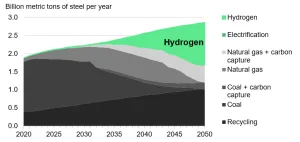
Source: BloombergNEF. Note: In this analysis, BloombergNEF have not considered blending hydrogen into blast furnaces, combinations of direct reduction (DR) furnaces with basic oxygen furnaces (BOF), or adding melters into the process.
Hydrogen based steel-making accounts for 42% of global production by 2050 in BNEF’s Net Zero Scenario. Hydrogen has the potential to replace coal and gas as both a primary fuel and the reducing agent for high-quality iron ore in the direct reduction electric arc furnace (DR-EAF) method of steel production. In BNEF scenarios hydrogen-based steel manufacturing processes make up the bulk of new steel production in 2050, at which point they account for around 88% of primary, and 57% of global steel production. High costs and a lack of supporting infrastructure are currently the biggest challenges for the hydrogen-based steel decarbonization route today.
“The steel sector emits almost four times as much CO2 as aviation, yet it is much less in the public eye,” said Claire Curry, Head of Technology, Industry & Innovation research at BloombergNEF. “We hope that this report, and the work and findings of the Coalition, will bring steel sector decarbonization to the forefront of policy makers, investors and customers’ minds. There is no lack of demand for lower-carbon steel, particularly in Europe. Therefore a main goal of this report is to reveal how new green steel projects, especially those that are hydrogen based, can reach financial close as soon as possible so as to meet this demand.”
Potential commercial and policy actions:
Commercial actions
- A ladder approach of focusing on the near-term motivated offtakers: Car or car part makers, home appliance manufacturers and specialized building material companies are three sectors with potential to make a business case for green products. Collaboration amongst construction sector buyers, at all times in accordance with antitrust laws, could be one way to show a strong demand signal and encourage greater levels of pricing transparency, as appropriate.
- Tap into new kinds of financing: To secure project funding, producers of low-carbon steel can find ways to secure long-term energy supply contracts and long-term green steel offtakes, so as to ensure stable profit margins. While traditional project finance may be wary of investing in the first few green steel projects, developers can look to secure funding from suppliers and customers. Other routes to project finance could include an advanced market commitment. Traditional steel makers may find it easier to raise the money to develop new green steel projects if they spin out a subsidiary, or form a joint venture, more able to access sustainable finance and debt markets.
- Lower the cost of hydrogen-based steel: Steelmakers can tap into low-cost 24/7 clean power to drive down the costs of hydrogen-based steel. This might mean some iron production relocates to places with cheap baseload clean power, such as hydro, nuclear or geothermal. For steelmakers that struggle to bear the high costs of switching to clean hydrogen now, they can start with lower-cost gray hydrogen feedstock – made using fossil fuels – to test out the equipment.
Policy actions
- Accelerate carbon pricing for the steel sector: One of the best policy tools for industrial decarbonization is carbon pricing. It is technology neutral and drives the lowest cost route to decarbonization. The EU Emissions Trading System, combined with the Carbon Border Adjustment Mechanism, could provide a blueprint for policymakers globally . Complimentary downside protection, through a mechanism such as a carbon contract for difference, could help protect projects against unexpectedly falling carbon prices.
- Streamline low-carbon steel standards: Defining what makes steel ‘green’ is essential if policy is to be designed to help it scale. Today there are many different industry-led standards. Policy makers and industry bodies should consider consolidating these standards, taking into account all emissions scopes and setting a declining emissions threshold in line with net zero.
- Government incentive programs to create green steel demand in construction: Government procurement accounts for up to 25% of steel buying in many markets. This means that newly established government green procurement programs could play an important role in kick starting green steel making. Policy makers should ensure the standards they set are strong enough to incentivize investment in new green steel making.
- Develop green building standards that include embodied emissions: Green building standards should include embodied emissions, which would spur demand for low-carbon steel. New policies, often at the city level, have begun setting mandatory reporting of embodied carbon emissions in buildings, sometimes with voluntary or mandatory carbon thresholds. Given that the construction industry consumes over half global steel production, policy such as this could have a significant impact on low-carbon steel demand.
“Action on the energy transition can’t happen in a vacuum, and initiatives like the Bloomberg New Economy’s Climate Technology Coalition are crucial in bringing together industry leaders capable of driving that action,” said Ahmed El-Hoshy, CEO, OCI Global and Fertiglobe. “In joining the coalition, I look forward to working alongside other pioneers to capture the opportunity and realize the decarbonization potential of hydrogen and its derivatives. This includes methanol and ammonia, where the coalition is helping to transform the entire value chain and make real change.”
Launched at the 2022 Bloomberg New Economy Forum, the Bloomberg New Economy Climate Technology Coalition was formed with the aim of identifying and rapidly scaling the next generation of climate-critical green technologies that will be instrumental in achieving the world’s climate goals. Led by a global Steering Committee of established leaders from across sectors and industries, this Coalition has set an ambitious agenda to unlock pathways to accelerate this timeframe to within a decade.
The Coalition Steering Committee possesses a global breadth and depth of expertise, bringing together leaders from India, China, North America, Africa, Europe, Australia, and the Middle East including: Michael R. Bloomberg, 108th mayor of New York City and founder of Bloomberg Philanthropies, Mark Carney, UN Special Envoy for Climate Action and Finance and Chair of Brookfield Asset Management; Head of Transition Investing; Chairman of the Board, Bloomberg, Natarajan Chandrasekaran, Chairman, Tata Sons, Bruce Flatt, CEO, Brookfield Asset Management, Andrew Forrest, Chairman and Founder of Fortescue, Sara Menker, Founder and Chief Executive Officer, Gro Intelligence, H.E. Khaldoon Khalifa Al Mubarak, Managing Director and Group CEO, Mubadala Investment Company, Neil Shen, Founding & Managing Partner of HongShan (Sequoia China), Lord Adair Turner, Chairman, Energy Transitions Commission, and Lei Zhang, Founder and CEO, Envision.
The Coalition will continue to identify and progress further low-carbon hydrogen related technologies, including the production methanol, that over the next decade will need to overcome production hurdles to scale, in order to accelerate the low-carbon transition. This report follows the Coalition’s first roadmap on decarbonizing ammonia production through clean hydrogen.
New members will be added to the Coalition in 2024. The new members are as follows:
- Ahmed El-Hoshy, CEO, OCI Global and Fertiglobe
- Seifi Ghasemi, Chairman, President and CEO, Air Products
- Chin Hua Loh, CEO, Keppel Corporation
- Dilhan Pillay Sandrasegara, CEO, Temasek Holdings
ENDS
About the Bloomberg New Economy Climate Technology Coalition
The Bloomberg New Economy Climate Technology Coalition aims to identify and rapidly scale the next generation of climate-critical green technologies that will be instrumental in achieving the world’s climate goals. It took several decades for renewables to reach today’s scale. The Coalition has set an ambitious goal to accelerate this timeframe to within a decade. It is led by a global steering committee of established leaders from across sectors and industries.
About BloombergNEF
BloombergNEF (BNEF) is a strategic research provider covering global commodity markets and the disruptive technologies driving the transition to a low-carbon economy. Our expert coverage assesses pathways for the power, transport, industry, buildings and agriculture sectors to adapt to the energy transition. We help commodity trading, corporate strategy, finance and policy professionals navigate change and generate opportunities.