

Leading With Conviction In An Uncertain World
At a glance
- Indecision has become a material business risk. Acting on imperfect information creates direction and learning; waiting often compounds uncertainty.
- Organizations are replacing single forecasts with shorter planning horizons, multiple base cases and clearer distinctions between reversible and irreversible decisions.
- Trust, candor and strong decision architecture are becoming strategic infrastructure, enabling teams and partners to move when outcomes cannot be predicted.
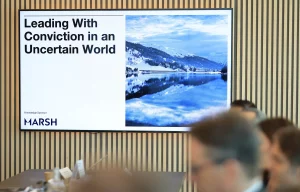
At a private roundtable at Bloomberg House Davos 2026, Bloomberg New Economy and Marsh convened leaders across technology, finance, investment, healthcare and professional services to explore what it means to lead with conviction in an uncertain world.
Held under Chatham House Rule, the discussion reached a central conclusion: resilience is no longer only a response to an isolated shock, it is a continuous capability shaping how organizations decide, support their people and preserve room to maneuver.
Indecision is becoming a material risk
Participants described a widespread slowdown in decision-making. Leaders are receiving more information, but with less confidence that today’s assumptions will remain valid tomorrow. The instinct is often to wait for clarity.
Yet delay can deepen uncertainty. A decision creates a course of action that can be tested, adjusted or reversed. An unresolved decision gives teams no direction and prevents the organization from learning.
One practical response is to separate “one-way door” decisions from “two-way door” decisions. Reversible choices can be made faster and closer to the point of action. Decisions with lasting consequences require broader scrutiny. This distinction keeps senior attention focused on the choices that matter most.
Speed also depends on culture. Employees need permission to make reasonable mistakes, surface them early and learn from them. As Nick Studer, President and CEO of Oliver Wyman and Marsh Management Consulting, put it: “The only sin about an error is not to learn from it.”
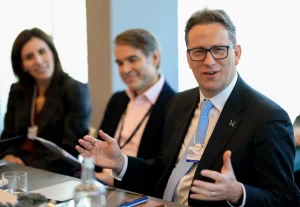
Nick Studer, President and CEO of Oliver Wyman and Marsh Management Consulting.
Planning for paths, not predictions
Participants questioned long-range strategies built around one expected future. The answer was not to stop planning, but to plan for several credible paths.
Shorter planning cycles, frequent recalibration and multiple base cases can test whether a strategy remains viable under different conditions. Investors described looking for several routes to an acceptable outcome rather than relying on a single high-conviction case. If success depends on only one set of assumptions, the strategy may be too fragile.
This reflects the difference between complicated and complex problems. Complicated problems may have many parts but can ultimately be solved. Complex conditions—such as geopolitical competition—keep evolving as governments, institutions and markets respond to one another. They must be sensed and navigated over time.
Competitive resilience therefore depends on optionality: alternative markets, business models, partnerships and strategic adjacencies that allow an organization to pivot when assumptions no longer hold.
Trust is the foundation for speed
As predictability declines, participants repeatedly returned to trust. Cross-border relationships now raise questions beyond price, performance or technical capability: how will a company respond to political pressure, protect critical data or maintain access to infrastructure if conditions deteriorate?
Security alliances, trading relationships and technology access increasingly follow different maps. Companies may be aligned with one power on security, another on trade and neither on technology policy. Trust must therefore be built through transparency, reliable governance and sustained human relationships.
Internally, trust allows decisions to move without unnecessary escalation. Externally, it reduces friction and can make possible investments or collaborations that would otherwise appear too risky.
Globalization, in this view, is not disappearing but becoming more fragmented and conditional. Capital is also reallocating at the margin rather than through wholesale exits. Regions able to absorb incremental flows with speed, scale and credible institutions will be best placed to benefit.
Resilience is a leadership capability
The discussion also emphasized the human dimension of resilience. Geopolitical and economic noise can divert attention throughout an organization—not only among executives, but among employees responsible for clients and daily operations. Sustaining workforce focus and health is therefore part of business resilience.
Candor matters. Employees may not expect leaders to predict every outcome, but they do expect clarity about what is known, what remains uncertain and how decisions will be made. Leaders in markets long accustomed to volatility may hold an advantage: greater comfort with ambiguity and more practice discussing it openly.
The stakes rise when organizations pursue transformative opportunities. A major acquisition, investment or expansion may create significant value while exposing the company—and its leadership—to forces beyond their control. Resilient organizations should not depend on individual heroics. They need clear decision rights, trusted advisers and governance systems that help leaders act with conviction without acting alone.
What competitive resilience looks like
The discussion surfaced four practical capabilities:
- Decision architecture: Match the speed and scrutiny of a decision to whether it is reversible.
- Optionality by design: Use multiple base cases, shorter planning horizons and clear pivot points.
- Rapid learning loops: Encourage action, surface errors quickly and apply what is learned.
- Trust-based operating models: Strengthen candor, accountability and relationships across teams and partners.
Conviction today does not mean certainty about what will happen. It means confidence in how an organization will decide, learn and adapt. The companies best positioned to compete will be those that move with discipline, preserve options and build the trust required to act when certainty is unavailable.
Marsh, who was a sponsor of Bloomberg House Davos, is the founding Co-Chair of the Bloomberg New Economy Competitive Resilience Coalition, a private sector-driven initiative helmed by a collective of forward-thinking global leaders to help today’s organizations tangibly strengthen competitive resilience: the ability to anticipate disruption, make better decisions under uncertainty, and sustain growth and competitiveness through periods of seismic change. Learn more at bloombergneweconomy.com/Competitive-Resilience