

Navigating a Water Crisis: A Scenario-Planning Exercise for Corporate Preparedness and Resilience
In a world transformed by climate change, water becomes a less and less reliable resource. Not only do the swings in extreme weather events—from prolonged droughts to flash floods—directly impact crop yields and our overall food systems, their unpredictability adds volatility to markets and limits the ability of communities, governments, and businesses to react and respond adequately as they move from one crisis to another. Already, several major cities and regions around the globe are suffering the worst droughts in living memory, including 4 billion people who experience high water-stress conditions at least one month a year, according to the latest data by the World Resources Institute’s Aqueduct Water Risk Atlas. And with the onset of the new El Niño season, which began in the second half of 2023, the situation will get worse for many in the immediate future.
Freshwater scarcity has vast implications for both human and planetary health, not to mention the economy. In this complex web of challenges, the corporate world finds itself at the intersection of responsibility and opportunity, where strategic investments in water resilience become not just a choice but a necessity to sustain an interconnected global economy that relies on consumption-led growth. Hence, in the same way that Covid-19 brought whole regions at a time to a standstill, the depletion of freshwater resources beyond certain thresholds could halt large-scale business operations and basic government services, forcing communities to a tipping point in which they no longer have access to replenishable groundwater.
This isn’t a distant, abstract threat; it’s a tidal wave inching closer, threatening to engulf industries, communities, and economic stability. Some 25 countries, home to 25 percent of the global population, are experiencing or nearing this “risk tipping point” by using up 80 percent of their freshwater resources. Regions such as North Africa and the Middle East are among the most affected. And agriculture, mining, manufacturing, energy production – all these sectors stand on the precipice of disruption if water scarcity is not mitigated proactively.
An idea born from the Health Council: Applying lessons learned from Covid to the era of the polycrisis
Built out of an idea from the New Economy Health Council on lessons in corporate preparedness from crises like COVID-19, we leveraged the power of scenario exercises to simulate an acute water crisis. Its first iteration, “Navigating a Water Crisis,” was tested in a breakout at the inaugural Bloomberg New Economy Gateway Africa in Marrakech, Morocco, where we convened 250 leaders from business and government June 13-14.
By simulating in real-time the pressures and anxieties of what is a troublingly plausible shock, the exercise challenged an intimate group of executives to think through the implications of a water crisis on their businesses and on society at large, weighing trade-offs across a series of decision points. We discussed when and how technology, research, human capital development, and more — as part of a thoughtful resilience strategy — can prevent, mitigate, or even seize opportunity in such moments of crisis.
The following guide lays out the logic and the steps of the exercise.
Setting the scene: Format, flow, and role playing
The 90 minute session included approximately 16 delegates and was facilitated by two subject-matter experts under Chatham House Rule, to encourage open and honest dialogue.
Upon arriving to the session room, each participant was handed one page that outlined a description of their role, company, and industry. This included additional context as to the direct impact and implications of the crisis on their business, including how each business uses water, context around the company’s history and approach to technology and water resilience strategies, and the two product/service options.
(Download the one-pagers.)
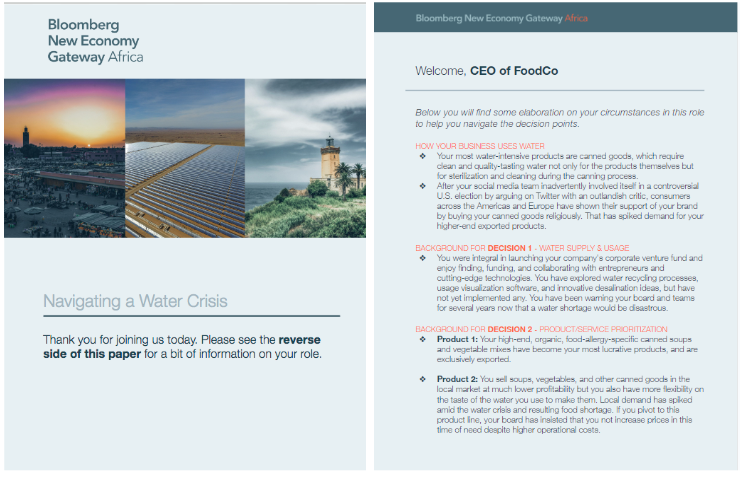
Each participant played the CEO of a company from a water-intensive industry, for which a generic name was invented and printed on a tent card. There were two representatives per industry, as per the list below, to allow for diverse perspectives and rationales to surface in decision-making.
- CEO of AirCo / CEO of AirportCo
- CEO of SolarCo / CEO of SunPowerCo
- CEO of PharmaCo / CEO of PharmaCeutiCo
- CEO of DrinksCo / CEO of BeverageCo
- CEO of BigAgCo / CEO of AgriCo
- CEO of ChemicalCo / CEO of ChemCo
- CEO of MiningCo / CEO of MetalsCo
- CEO of FoodCo / CEO of EatsCo
A short video at the top of the session helped to set the scene around a fictitious—but probable—water crisis affecting a region along a vital river in the African continent. The statistics used were extrapolated from the projected impact of prolonged drought conditions that coincide with the completion of the continent’s largest dam, the Grand Ethiopian Renaissance Dam, which is expected to be completed by 2024.
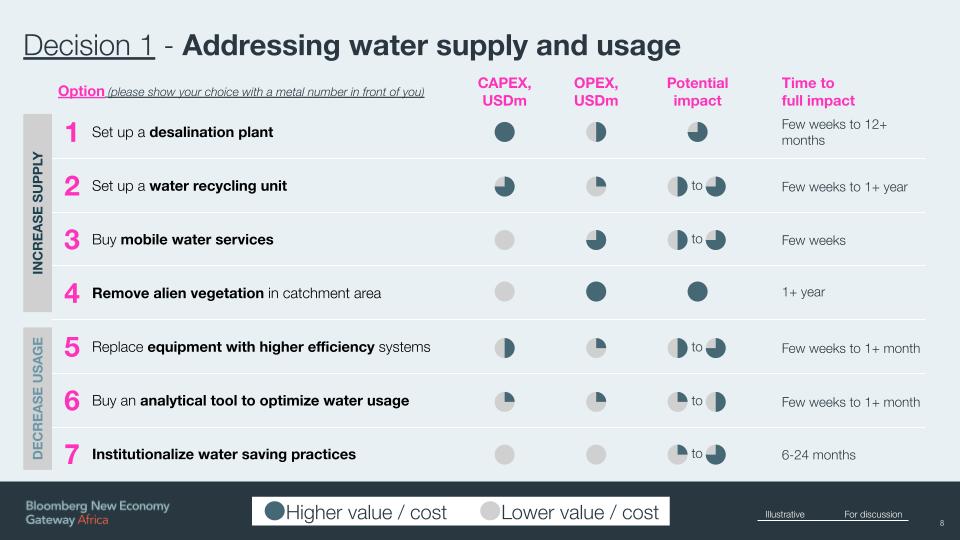
After the set-up, participants were guided through a series of three decision points, which were accompanied by a set of numbered answers. Participants were given 2-3 minutes to submit their responses in the form of a numbered tent sign and were invited to share the reasoning behind their decision.

The three decision points took place along a shrinking timeframe, creating a sense of urgency as they considered being…
- 4 months away from operational disaster: what solutions and technologies to implement, according to capital expenditure, operational expenditure, potential impact, and time to full impact
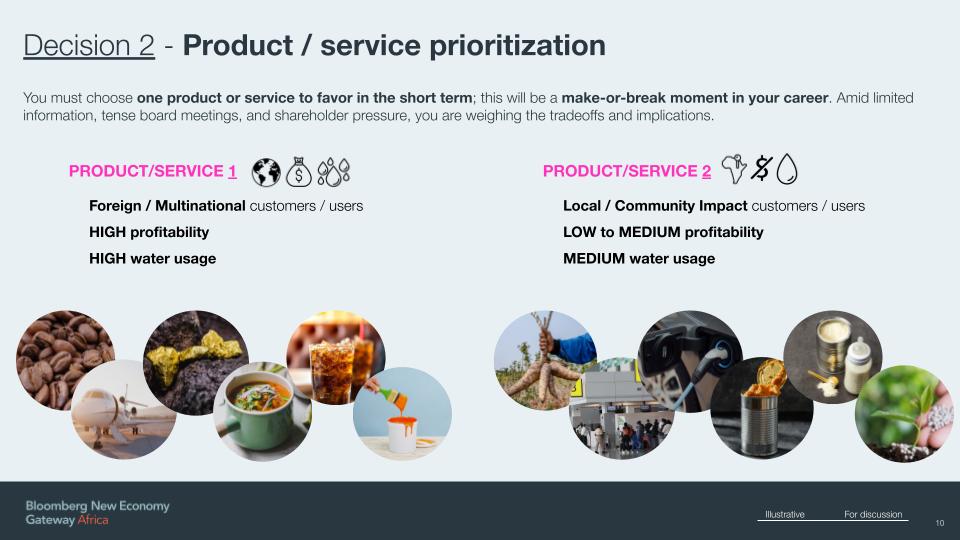
- 3 weeks until you can no longer operate business as usual: what products or services to prioritize in the short-term, with one option that prioritizes foreign/multinational customers/users, high profitability, and high water usage; and another geared toward the local community, with low to medium profitability and medium water usage
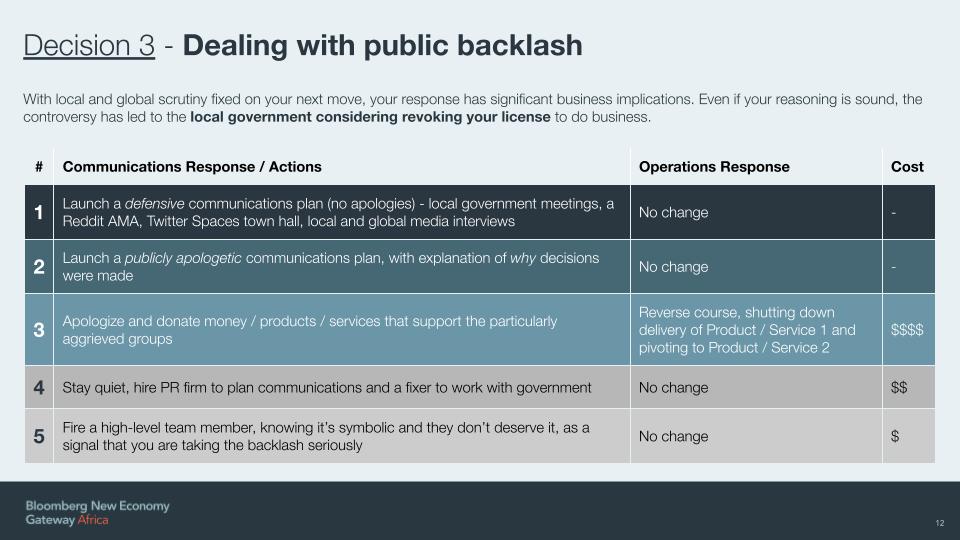
- And 5 days away from a complete halt in operations: dealing with a public backlash by taking into account communications strategy, operational response, cost
Reflections on resilience: Helping corporations along their water-resilience journey
Choosing one primary solution to focus on proved to be difficult to participants, who preferred flexibility and optionality—a luxury we take for granted in peace times. Many cited added complications due to local circumstances that might tip the scales toward choosing one method over another. For instance, mobile water services can be prohibitively expensive for some regions while being the only viable option for others. Regardless, the demand for such services will almost certainly increase, played up by buillishness we see today among private equity investors.
While participants applied an immediate problem-solving approach to decision one, they took the long view when it came to prioritizing a foreign versus local customer base. In most cases, participants opted for whichever market they believed core to their business continuity, which would in turn allow them to eventually have a positive local impact in the long run. Ultimately, public perception can’t be discounted, as was put to the test in decision three.
Upon wrapping up the discussion on the final decision point, the expert facilitators revealed real trends, statistics, and actual events underscoring the probability of such a scenario. Indeed the implications are vast for a wide array of businesses, yet few have water resilience strategies to mitigate and manage the risks, from the operational to the reputational.
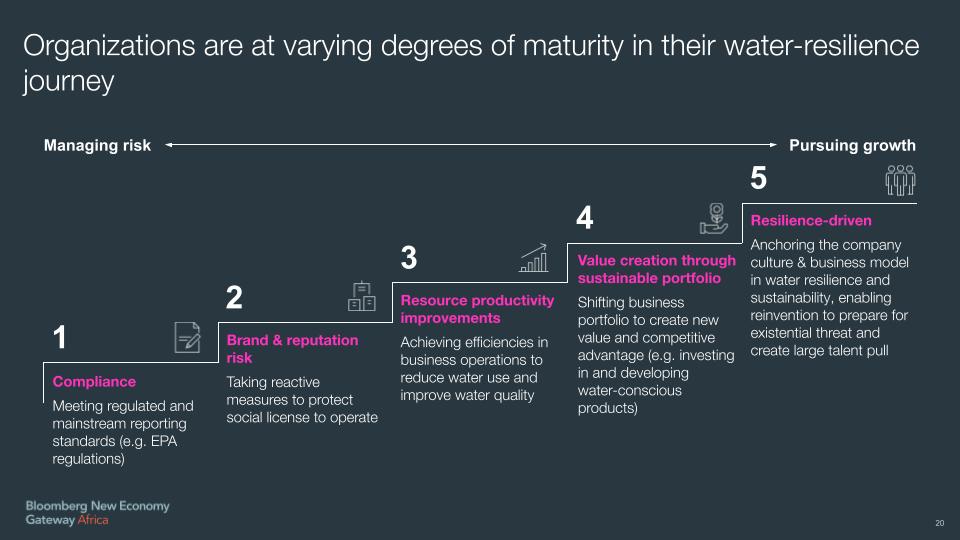
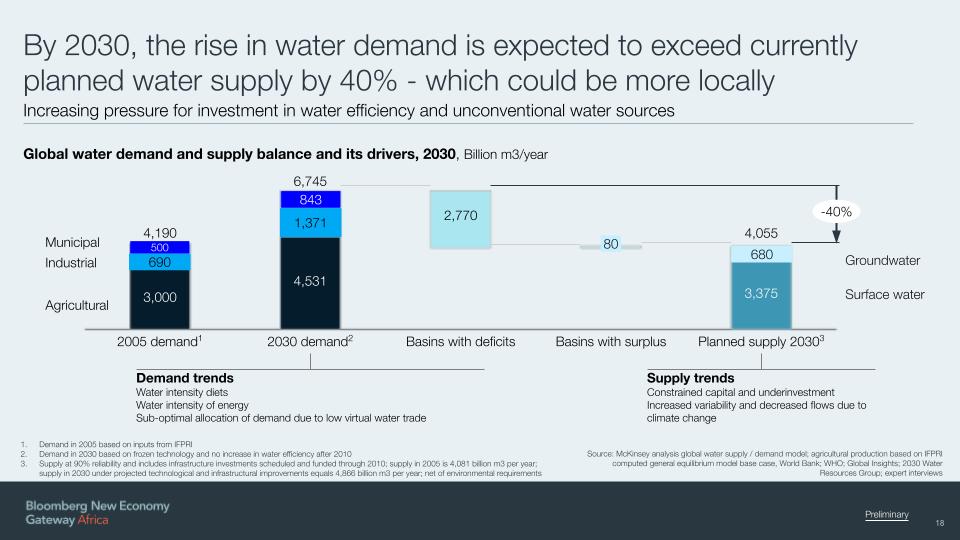
The group discussed long-term planning, cross-industry partnerships, and investments that can manage such risks without sacrificing growth. And while the costs upfront might seem daunting, they will be even more so in times of crisis. Fortunately, many technologies and solutions that improve efficiencies in the use of water already exist and can be used as levers to close the gap between supply and demand, projected to be as much as 40 percent globally by 2030.
- Download the full presentation.
- Read takeaways from a “Roundtable Spotlight: Water is Everyone’s Business.”
- For more information, contact Carolina Aguilar (aguilar23@bloomberg.net) and Elizabeth Gonzalez (egonzalez223@bloomberg.net).