

Powering Progress: Advancing Renewable Energy and Smarter Demand
At a glance
- Asia’s path to decarbonization is being shaped by fast-growing energy demand, fragmented regulatory frameworks, and an urgent need for both clean supply and smarter demand.
- Participants called for stronger policy coordination and long-term visibility to enable investment, as well as greater collaboration between corporates, financiers, and governments.
- Scope 3 emissions remain the toughest frontier, demanding innovation in supplier engagement, financing models, and ecosystem partnerships.
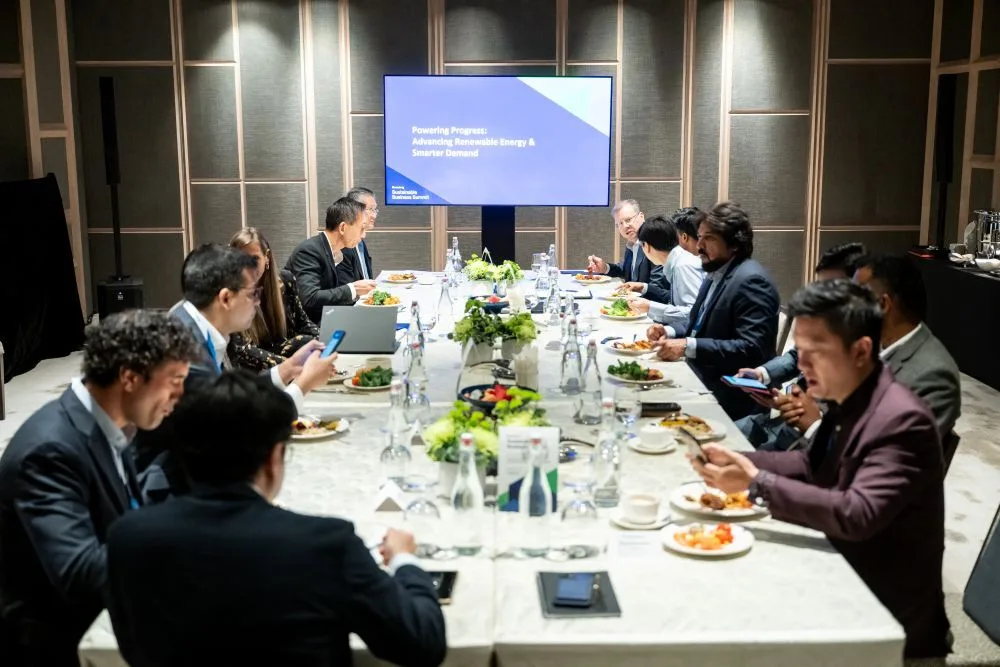
At a roundtable during Bloomberg’s 2025 Sustainable Business Summit in Singapore, titled “Powering Progress: Advancing Renewable Energy and Smarter Demand,” co-hosted with Schneider Electric, participants discussed challenges and opportunities for their organizations’ energy transition and the regional outlook for renewables, among other topics. Attendees based in the Asia-Pacific region represented a diverse ecosystem, ranging from regional infrastructure operators and developers to major global financial institutions, sovereign funds, and technology hyperscalers, ensuring a topical and holistic exchange.
“Policy plays two roles: to enable decarbonization when the technology is ready, and to accelerate it”
To open the discussion, participants were encouraged to share their pain points under Chatham House Rule, with two questions to kick-off the discussion:
- On a scale from 1 to 10, where is your organization or department in its sustainability journey? (1 = barely started → 10 = fully embedded across strategy and day-to-day operations)
- What’s one thing holding you back from more progress?
When it came to sustainability journeys, most of the room reported having fairly sophisticated sustainability strategies or being in an advanced stage of decarbonizing their own operations. The final tally showed 7 as the most frequently cited number, followed by a tie between 8 and 3.
As for the painpoints, the consensus was clear: policy uncertainty is the greatest bottleneck. One participant identified three major areas where policy stands in the way of progress: Grid buildout and financing, diverging economics of renewables across different markets, procurement and varying procurement modalities/
Several investors emphasized that while innovation and capital are available, what’s missing is regulatory clarity. “Without long-term policy visibility, companies can’t plan their decarbonization trajectory,” one investor lamented.
However, participants highlighted India and Australia as regional bright spots for progressive policy, with open-access renewable frameworks and green corridor initiatives providing confidence for large-scale private sector investment. As one participant put it, if regional governments facilitated additional private sector participation on grid build out, it would enable them to transition much faster to adding more renewable energy to the grid.
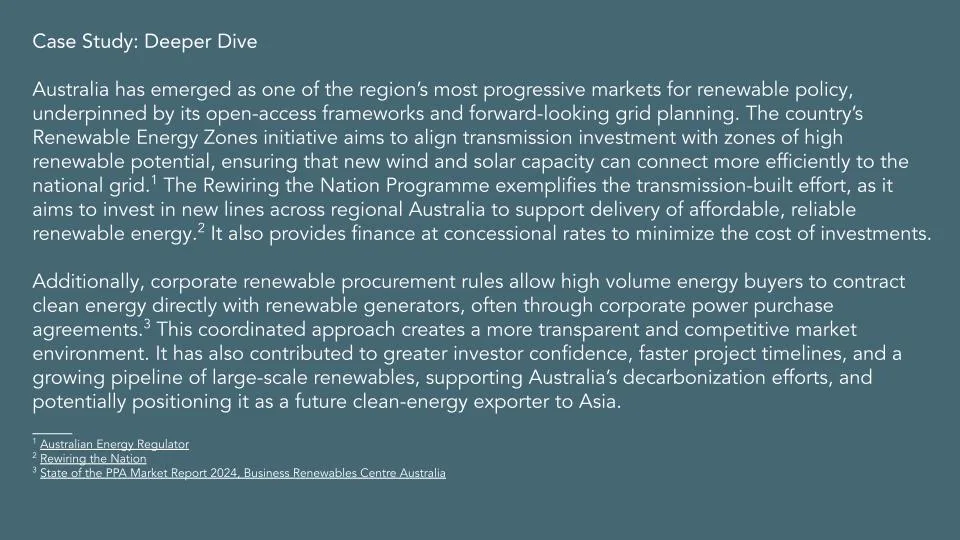
Further, developers and financiers at the roundtable cited inconsistent policy and financial frameworks across Southeast Asia as slowing down renewable procurement and grid expansion. As one participant put it, “it’s political will and regulatory frameworks that will enable us to deploy more renewable solutions.”
One political barrier comes from governments in the region being sensitive to the impact on jobs, though education can go a long way toward highlighting the very real job opportunity and skills development presented by the energy transition.
For investment managers, frameworks are especially helpful in order to be able to offer concrete advisory to clients on their transition plans, even more so as some see demand drop for sustainable attributes.
While local policies might be inconsistent, Asia’s geopolitical stability provides a unique advantage. Roundtable host Farrukh Shad, Senior Vice President and Head of Sustainability Business (APMEA) at Schneider Electric, reinforced this point: “We can—and must—capitalize on that by designing frameworks that accelerate private-sector deployment.”

Farrukh Shad, Senior Vice President and Head of Sustainability Business (APMEA), Schneider Electric.
“Eliminating scope 3 emissions is one giant animal to slay”
Tech voices in the room pointed to grid decarbonization and market rules as key hurdles to tackling scope 3 emissions, with one participant sharing that their “single biggest constraint in Asia is access to carbon-free power.” Further complicating this, another participant pointed out, pathways to grid decarbonization in the region are also not always clear. To limit scope 3 emissions, these pathways must be defined given that growth of regional supply chains, along with the logistics market, is projected to almost double in the next decade. Then add to this power consumption from AI and data centers, the annual demand from which increases from over 10 TWh today to 25 TWh by 2030.
“A common voice to solve a common problem”
To address challenges identified in the session, participants agreed that a common approach was needed. Compared to Europe and the US, organizations represented at the roundtable felt that in Asia, there is a lack of private sector coordination to come together as a united front for engagement with government bodies. Instead, there seems to be a narrower approach focused on bilateral conversations. As Shad concluded, the task now is to “move from conversation to collaboration.”
Schneider Electric, who was a sponsor of Bloomberg Live’s Sustainable Business Summit Singapore, is the founding Co-Chair of the Bloomberg New Economy Energy Technology Coalition, a private sector-driven initiative helmed by a collective of forward-thinking global leaders across industry and infrastructure accelerating the deployment of demand-side technologies. Learn more at bloombergneweconomy.com/EnTech