

Your Next Growth Market May Not Have a Skyline: What business leaders should know about midsize cities, talent hubs, and regional clusters
Your Next Growth Market May Not Have a Skyline: What business leaders should know about midsize cities, talent hubs, and regional clusters
The following is an article written by Ben Simpfendorfer, a member of the Dynamic Cities Coalition and Head, Oliver Wyman Forum, Asia-Pacific and author of Oliver Wyman Forum’s report on “The Cities Shaping the Future”.
The average multinational corporation today operates in more than 120 cities, yet the geography of business opportunity is becoming even more distributed. While established global hubs remain critical, talent scarcity, demographic divergence, the rise of midsize cities, and the growing importance of regional clusters are reshaping where companies invest, hire, innovate, and expand.
The next decade of growth for businesses will depend more on a portfolio of different cities that contribute distinct advantages across talent, industry, expertise, and connectivity, according to an Oliver Wyman Forum analysis of 1,500 cities representing more than three-quarters of global GDP.
Leaders will have to look outside of the world’s largest metropolises to assemble this portfolio. Young, innovative talent and specialized workers are spreading across different markets and creating a combination of advantages less attainable by lone cities, while midsize cities offer affordable access to new industries.
Midsize Cities Are Becoming Too Big to Ignore
Opportunities are extending beyond the traditional group of global business capitals. Midsize cities are benefitting from supply-chain realignment, industrial investment, lower operating costs, affordability, and the development of specialized innovation sectors. Many of these cities allow companies to capitalize on lower costs without necessarily sacrificing regional proximity, offering direct flight connections to at least 10 destinations.
Midsize cities across both developed and emerging markets represent an estimated $19.2 trillion in annual household consumption, creating an advantage for companies that can identify early where and why durable growth is occurring.
Policy initiatives and macroeconomic turns are driving momentum for many of these cities. For instance, Surat, India and Da Nang, Vietnam are benefitting from supply chain shifts, while national policies to develop non-oil sectors are expanding Saudi Arabia’s Dammam and Azerbaijan’s Baku. Others with lower housing costs and reasonable commute lengths to commercial hubs, like Italy’s Turin relative to Milan, are capturing wealth and young talent looking for a higher quality of life.
Worker migrations that create new talent ecosystems determine where innovation happens and what separates tomorrow’s leading cities from the rest. Just as midsize cities like Austin and Denver became startup alternatives to San Francisco, cities such as Hamburg and Manchester offer alternatives to European innovation centers like Paris and Munich.
Technology Is Advancing Everywhere. The Talent to Build It Isn’t
Even as talent migrates, many workers in AI and advanced industries remain concentrated around a relatively small number of tech companies and research universities. The talent to build these sectors and technologies is becoming harder to attract and retain. It’s top of mind for many executives, with half of CEOs viewing talent attraction, retention, and development as a key opportunity over the next three years, according to a 2026 survey by the Oliver Wyman Forum and the New York Stock Exchange.
Locating offices in cities with strong STEM universities, vibrant venture capital scenes, or a mixture of world-class multinationals and emerging startups can attract workers by offering them more career and education opportunities. These can be attractive at a time when demand for upskilling is high: Only a third of employees say they are getting the skills they need, according to a five-year survey of almost 300,000 workers across 20 nations by the Oliver Wyman Forum.
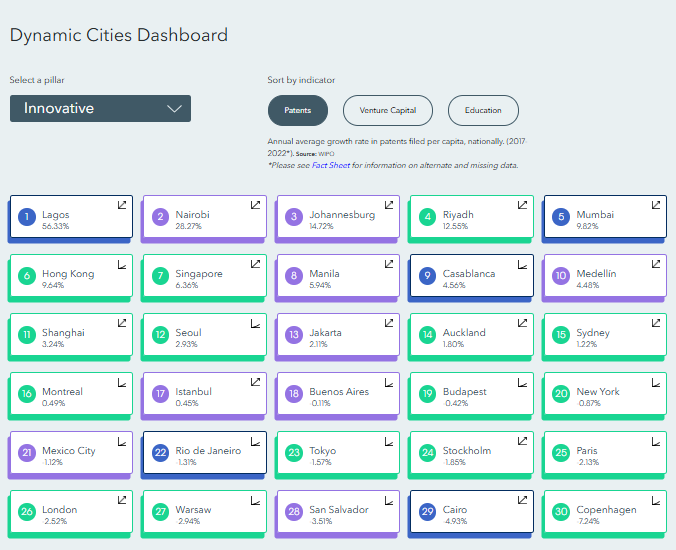
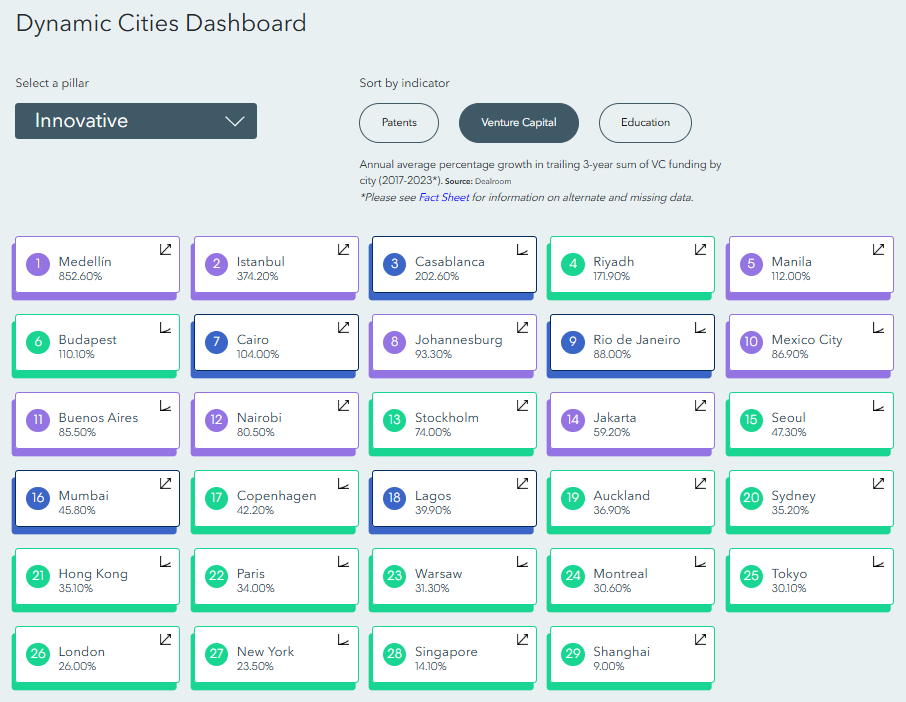
Cities like London, Boston, or Seoul are obvious candidates, but smaller cities are just as primed for innovation. Budapest, Riyadh, Istanbul, Medellin, and Nairobi offer a high concentration of universities, venture capital funding, and patent activity, according to Bloomberg’s Dynamic Cities Dashboard. For CEOs looking to expand, identifying cities with high innovation environments and concentrations of multinational firms can help them access deeper talent pools and reduce execution risk.
And when talent simply isn’t available locally, businesses should outsource it. Competition is fierce in traditional business process outsourcing hubs like India’s Hyderabad or the Philippines’ Cebu, but leaders can tap other outsourcing centers based on metrics like graduation rates, transit connectivity, or digital infrastructure strength. Cairo, for example, is a young engineering talent hub for European automotive players; the median age there is only 26, compared with mid-40s in Asian and European cities like Osaka and Essen.
Your Next Market May Be a Cluster, Not a City
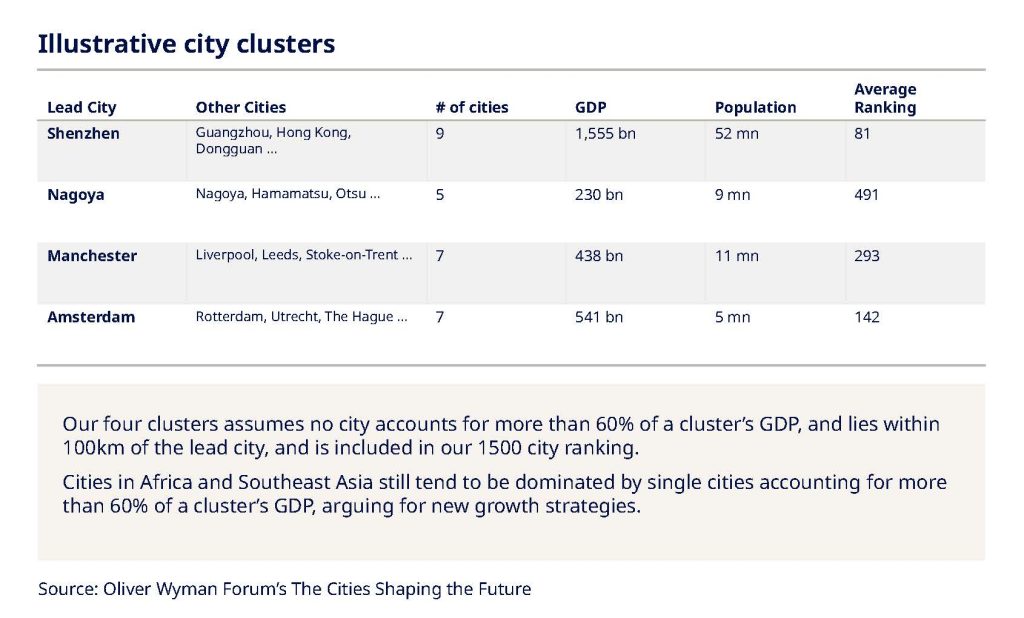
Even the strongest talent hubs cannot provide every capability that a global business requires. Rather, companies can tap connections between cities. Regional clusters can combine finance, manufacturing, logistics, research, and talent across nearby cities.
Consider Hong Kong. The city’s strength increasingly lies in its position as part of a dynamic triangle with neighboring Shenzhen and Guangzhou. Together, the three cities boast global investment banks, manufacturing giants, and technology innovators; with a combined GDP of $1.4 trillion and 48 million people living within a one-hour high-speed rail trip, the region amounts to a market larger than Tokyo. Similar clusters are seen in Dallas, Austin and Houston, or in Singapore, Johor and Batam. Firms can even unbundle their functions, for example by placing executive leadership in Singapore, outsourced services in Johor, and manufacturing in Batam.
The era of a small, fixed number of dominant cities is giving way to one with diverse competitors, in part shaped by sweeping policy ambitions to boost growth, competitiveness, and quality of life like those implemented in Malaysia or Saudi Arabia. Other policymakers are embracing regional portfolio strategies in a bid for growth, like in Johor and Singapore, which have formed their own cooperative cluster to attract businesses. Malaysian officials attributed $13.2 billion in approved investments in the first half of 2025 to its special economic zone with Singapore.
These policies could prove prescient for city governments managing several transformations simultaneously with limited fiscal and administrative capacity. They must adapt infrastructure to extreme weather, modernize transport and public services, deploy digital and smart-city technologies, and prepare workers for rapidly changing skill requirements.
The relationship between businesses and cities will extend further than decisions about where to locate an office, a factory, or a sales team. Companies should work with city leaders as long-term partners, providing capital, technology, operational expertise, workforce programs, and access to innovation. In practice, that could include working with a local university on training courses, or co-investing in climate resilience or digital infrastructure.
Cities can draw investment by offering a facet of growth for businesses, while business leaders have a chance to build their city portfolios by establishing footholds in emerging hubs.
The Bloomberg New Economy Dynamic Cities Coalition advances an action-oriented agenda for urban transformation by convening city governments, investors, developers, architects, businesses, and urban experts to identify and accelerate solutions that strengthen urban competitiveness, resilience, and sustainability.
Grounded in data and evidence, including insights from the Dynamic Cities Dashboard, the Coalition supports collaborative research, convenings, case studies, and strategic communications that showcase successful urban innovations, inform business and public-sector decision-making, and accelerate the development of more sustainable, inclusive, and economically dynamic cities.
Bloomberg New Economy Coalitions are data-driven, community-led initiatives that bring together leading experts across the public and private sectors for dialogue, collective recommendations and commitments, and coordinated action around urgent global challenges. Bloomberg New Economy is currently working on three coalitions: the International Cancer Coalition, the Dynamic Cities Coalition, and the Energy Technology Coalition.
ENDS
By Setonji Agosa, Manager, Bloomberg’s New Economy Coalitions & Community Innovation. For inquiries, contact: sagosa@bloomberg.net