
UNGA Week: A High-Level Convening on Closing the Cancer Equity Gap
September 25, 2025
On the sidelines of the 80th session of the UN General Assembly in New York, the Bloomberg New Economy International Cancer Coalition, in partnership with American Society of Clinical Oncology (ASCO), convened ministers, multilaterals, clinicians and financiers for a conversation on shifting the cancer timeline from late-stage crisis to early-stage prevention and building a financially sustainable engine to support it.
“Cancer knows no boundaries—and neither can our response,” said Karen Saltser, CEO of Bloomberg Media and a breast cancer survivor, opening the session and underscoring the role of modern platforms in forging public-private-people partnerships. ASCO President-elect Dr. Elizabeth (Beth) Mittendorf reinforced the clinical thesis: early detection saves lives, lowers costs, and improves outcomes—especially for women’s cancers.
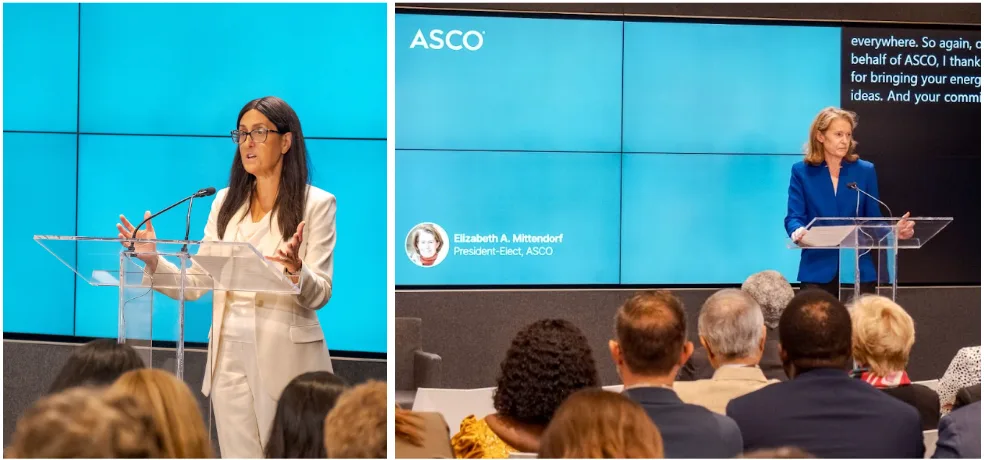
Karen Saltser (left) and Dr. Elizabeth (Beth) Mittendorf (right) opened the session underscoring the power of different sectors collaborating on a common cause.
The Challenge
“Cancer now causes more premature deaths than HIV, TB, and malaria combined, yet receives less than 5% of global health funding”, noted Dr. Catharine Young, Senior Fellow at Harvard T.H. Chan School of Public Health and Former Assistant Director of the Biden Cancer Moonshot. “Closing this gap is both necessary and achievable,” said Dr. Young. “As with any global challenge, progress demands a tangible goal and a practical entry point. For the Global Cancer Financing Platform (GCF), that means starting with cervical and breast cancer, among the most preventable and treatable cancers when detected early.”
The World Health Organization’s Director of Noncommunicable Diseases and Mental Health, Dr. Dévora Kestel, likened this approach to the WHO’s Cervical Cancer Elimination Initiative, emphasizing equity, integration and the scaling of proven interventions such as cervical cancer elimination and early breast cancer detection.
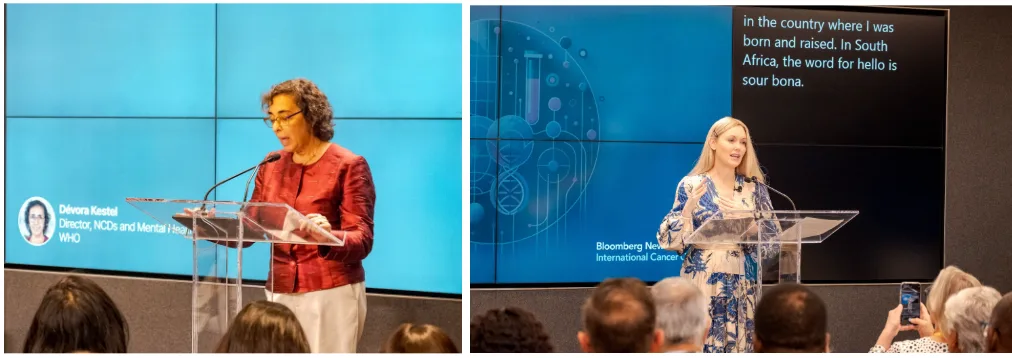
WHO’s Dr. Dévora Kestel (left) and Dr. Catharine Young (right)
Innovation and Partnership
For more than two decades, patients, clinicians and policymakers have called for a dedicated cancer financing mechanism on par with the Global Fund for HIV, TB, and malaria. With more than 19 million new diagnoses and nearly 10 million cancer deaths worldwide per year, cancer is equally demanding of a global fund approach.
Dr. Young shared that this is what the GCF initiative aims to do: mobilize at least $1 billion by 2030—with a path to $5 billion—to close the global cancer equity gap, starting with women’s cancers and expanding to other high-burden cancers.
Over the past year, the nascent platform has convened governments, nonprofits, multilaterals, the private sector, advocates, and patients, officially launching at the ACSO Annual Meeting in May with more than 50 organizations aligning on scope and focus.
“Partnership is vital, not optional.”
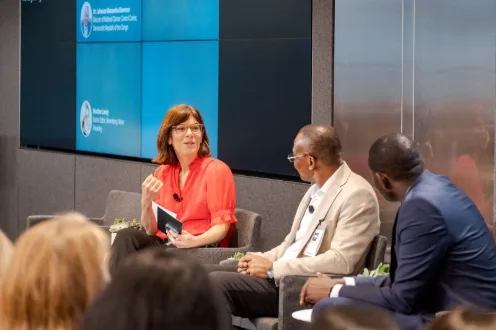
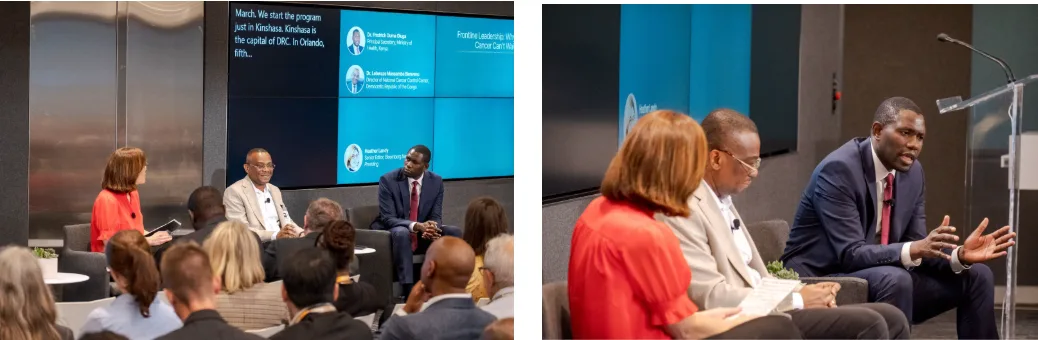
Heather Landy moderated a conversation with Dr. Fredrick Ouma Oluga and Dr. Lebwaze Massamba Bienvenu on how to translate this vision into action at the country level
A panel with Dr. Fredrick Ouma Oluga, Principal Secretary at Kenya’s Ministry of Health, and Dr. Lebwaze Massamba Bienvenu, Director of the National Cancer Control Center of the DRC, agreed partnership is “vital, not optional.” In conversation with Bloomberg’s Heather Landy, both leaders emphasized the need to “walk the journey together”—from equipment procurement and maintenance to workforce training and public education. Translating vision into operations, they identified four urgent execution gaps:
- Awareness and training: Building meaningful awareness for communities and clinicians across the care continuum, not just among oncologists.
- Infrastructure and geography: Expanding beyond a few comprehensive centers to reach wider populations reliably.
- Financing: Mobilizing domestic resources and ensuring equitable pricing through durable partnerships.
- Data systems: Strengthening national registries and integrated health records to track patient journeys, reduce loss to follow-up, and trigger early interventions.
The recurrence of these themes across regions—and in the Coalition’s regional taskforces—showcases the need for cross-border and pre-competitive, industry-wide collaboration.
Mobilizing for Improved Outcomes
A second panel explored key levers to finance and scale equitable cancer care. Felice Gorordo, former U.S. Executive Director at the World Bank, emphasized that the goal is not to duplicate existing efforts but to create a future-ready financing engine built on transparency where every contributor can trace resources from commitment to clinic.
“The money exists; we just have to mobilize it and link it to outcomes.”
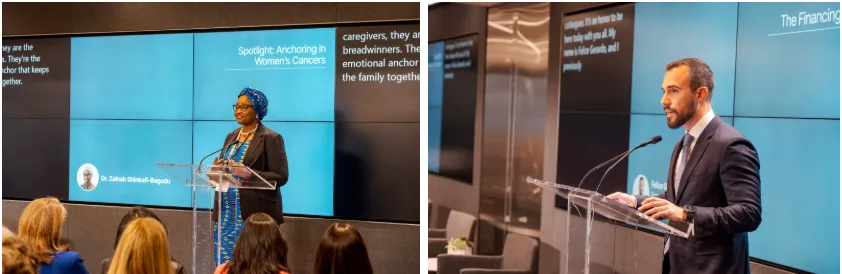 Dr. Zainab Shinkafi-Bagudu, UICC President Elect 2024-2026 and Founder of Medicaid Cancer Foundation, (left) and Felice Gorordo, former U.S. Executive Director at the World Bank (right)
Dr. Priya Agrawal highlighted blended finance in action and cited Indonesia’s model combining a World Bank loan, debt buy-down, and technical assistance to de-risk HPV vaccine uptake—proof, she said, that “the money exists; we just have to mobilize it and link it to outcomes.”
Bloomberg New Economy International Cancer Coalition member and MedServe CEO Dr. Tolulope Adewole underscored the untapped potential of sovereign wealth funds, referencing models in Morocco, Turkey, and Nigeria. “These are underused engines for long-horizon investment,” he said. He also pointed to “sin taxes” on alcohol and tobacco as viable demand-side financing tools to fund treatment, while Dr. Agrawal closed by calling for AI-enabled “leapfrogging” to overcome oncology workforce gaps, mirroring the mobile banking revolution in Africa.
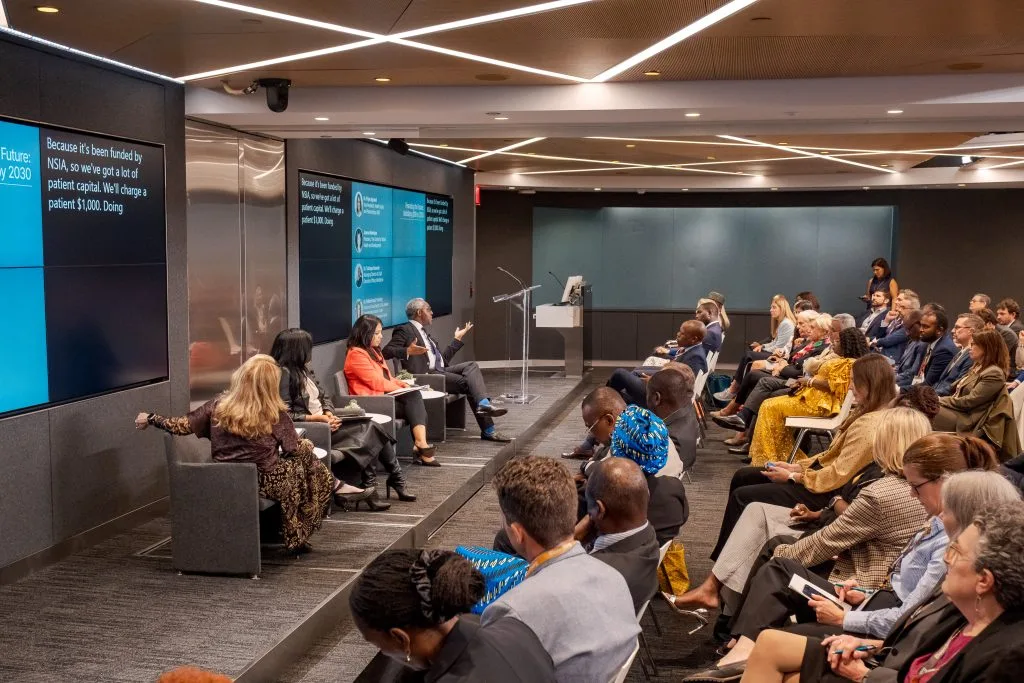
Dr. Tolulope Adewole (far right), highlighted the need for measured, sustainable government action to ease the cancer burden on patients and healthcare systems.
Uganda Announces Pilot for Remittance-Powered Cancer Financing
H.E. Robie Kakonge, Ambassador of The Republic of Uganda to Washington, DC, announced at the gathering, a pilot to channel diaspora remittances developed with GCF. “Each year Ugandans abroad send billions home to support their families. These remittances are lifelines—keeping children in school, putting food on the table. Now, we want to ensure they can also strengthen our health system, funding screening, diagnostics, and treatment that save lives.” Early interest from Tanzania, Gabon, DRC, Nigeria, and others signaled that a broader cohort may follow.
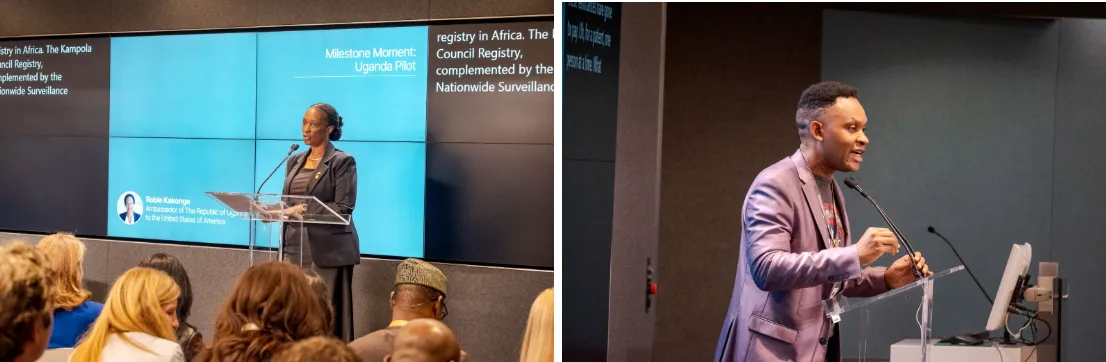 H.E Robie Kakonge, Ambassador of The Republic of Uganda to Washington, DC (left),
Dr. Wil Ngwa, Director, Global Health Catalyst; Chair, Lancet Commission on cancer in sub-Saharan Africa, United States (right)
About The International Cancer Coalition
The mission of Bloomberg New Economy International Cancer Coalition, a subsidiary of Bloomberg Media, is to convene groups of multi stakeholder experts– ranging from academia, industry, government, patient advocacy and policy think tanks– and to promote partnerships that help advance health equity by accelerating cancer cures and prevention through technology and collaboration. Bloomberg New Economy Coalitions are data-driven, community-led initiatives that bring together leading experts across the public and private sectors for dialogue, collective recommendations and commitments, and coordinated action around urgent global challenges.
For inquiries, contact:
Sepideh Shokrpour
Related: The Lancet Oncology – International funding for cancer care: a shared responsibility